

Where Should an IV Pole Be Mounted on a Hospital Bed, and Why Does It Matter?
When hospitals purchase new patient beds, most attention goes to the main functions: backrest adjustment, leg positioning, overall height adjustment, side rails and braking systems. Smaller components such as IV pole holders are often mentioned only briefly in the quotation.
However, the way an IV pole connects to a hospital bed is an important part of the complete product configuration. Two hospital beds may both include an IV stand, but their mounting positions, socket construction and installation arrangements can be different.
A Hospital Bed with IV Pole typically uses dedicated mounting sockets or holders connected to the bed structure. These components provide designated installation positions for a compatible removable IV stand.
For medical equipment distributors and hospital procurement teams, evaluating the complete mounting system is more useful than simply confirming that an IV pole is included in the accessory list.
How Is an IV Pole Mounted on a Hospital Bed?
On many medical hospital beds, the IV pole is installed into a designated socket attached to the bed frame or another manufacturer-approved mounting structure.
The exact arrangement depends on the hospital bed model and its intended functions.
Integrated IV Pole Mounting Sockets
An IV pole socket provides the connection point between the removable stand and the hospital bed.
Depending on the bed design, the socket may be constructed from a metal tube, reinforced sleeve or another suitable mounting component.
The opening must be compatible with the insertion section of the specified IV pole.
Steel Mounting Sleeves
Some hospital bed frames incorporate steel mounting sleeves at designated positions.
These sleeves provide support and help locate the IV pole during installation.
Their dimensions and attachment methods should correspond to the manufacturer's approved accessory specifications.
Connection to the Main Bed Structure
The mounting socket must transfer the permitted accessory load to the supporting bed structure.
Depending on the model, the socket may connect to a corner bracket, structural frame member or another reinforced mounting area.
Buyers should inspect the actual connection instead of assuming that the visible socket alone determines stability.
Why the Socket Position Matters
The mounting position affects access to the IV pole and its relationship with the bed's adjustable sections, side rails and surrounding medical equipment.
A socket that is convenient on one bed model may not be appropriate for another configuration.
What Makes a Removable IV Pole Suitable for a Hospital Bed?
A hospital bed IV pole is generally a vertical accessory designed to support specified infusion equipment within the manufacturer's approved limits.
Its components must be compatible with the mounting socket and intended operating conditions.
Vertical Supporting Tube
The main pole provides the vertical structure.
Depending on the model, it may use stainless steel or another specified material suitable for its intended healthcare environment.
Buyers should confirm the tube dimensions, material and load rating.
Height Adjustment Mechanism
Selected IV poles incorporate a telescopic tube that allows the height to be adjusted.
The adjustment mechanism may use a locking collar, knob or another approved retention arrangement.
The pole should remain securely positioned at the selected height under its specified load conditions.
Upper Hooks
The upper assembly may include two, four or another model-specific number of hooks.
These hooks are intended for approved infusion equipment within the manufacturer's stated limitations.
The number of hooks does not automatically establish the maximum permitted load of the complete pole.
Lower Insertion Section
The lower section is designed to fit the compatible hospital bed mounting socket.
Its outside diameter, insertion length and construction should match the designated holder.
Check the Pole and Socket Together
A removable IV stand should not be considered universally compatible with every hospital bed simply because its overall appearance is similar.
Buyers should verify the actual pole-to-socket connection before ordering replacement accessories or combining components from different manufacturers.
Where Are IV Pole Sockets Usually Positioned?
Hospital bed manufacturers may provide one or more mounting locations depending on the intended product configuration.
Head-End Mounting Positions
Some hospital beds provide IV pole sockets near the head end.
These locations may offer convenient access for certain bedside equipment arrangements.
However, the mounting position must remain compatible with the headboard, side rails and other nearby components.
Foot-End Mounting Positions
Selected hospital bed models also offer mounting locations near the foot end.
These positions provide additional flexibility when the approved clinical setup requires a different accessory arrangement.
Multiple Socket Configurations
Depending on the model, a hospital bed may incorporate mounting sockets at more than one corner.
This gives trained staff different approved positions for the IV pole.
Buyers should confirm the actual number of sockets rather than assuming that all four corners are equipped.
Mounting Location and Bed Movement
Where the socket is attached to an upper moving structure, its position relative to the floor may change during height adjustment.
On other designs, the connection may behave differently.
The exact mounting location and movement relationship should be checked on the selected hospital bed.
How Does the IV Pole Work with an Electric Hospital Bed?
Electric hospital beds may provide several powered positioning functions.
The accessory mounting arrangement must be compatible with these movements.
Backrest Adjustment
When the backrest rises, the position of the mattress platform changes relative to surrounding components.
The IV pole and its approved equipment arrangement should not obstruct the movement of the backrest or other bed structures.
Overall Height Adjustment
On height-adjustable electric hospital beds, the upper bed structure moves within a specified vertical range.
The position of a bed-mounted IV pole may therefore change depending on how its socket is attached.
Buyers should inspect the clearance available at both the minimum and maximum bed heights.
Trendelenburg and Reverse Trendelenburg
Selected ICU hospital beds provide longitudinal tilting functions.
During these movements, the orientation of bed-mounted accessories can change relative to the room.
The IV pole configuration and attached equipment must remain within the manufacturer's permitted operating conditions.
Electrical Cables and Infusion Tubing
Infusion tubing, electrical cables and other connections must be managed according to the approved clinical procedure.
They should not become trapped, stretched or damaged during bed movement.
Accessory Compatibility Is a Complete-System Issue
The bed frame, moving platform, IV pole socket and attached equipment should be evaluated together.
Safe operation cannot be established by inspecting only the IV pole itself.
Why Does the Mounting Structure Need to Be Strong Enough?
The mounting socket and its connection to the bed frame must support the accessory loads specified by the manufacturer.
Load Transfer Through the Socket
The load carried by an IV pole is transmitted through the vertical tube and its mounting connection.
The socket and supporting structure must be appropriate for the intended use.
Welded and Mechanical Connections
Depending on the construction, mounting components may use welded brackets, mechanical fasteners or other approved methods.
Buyers should inspect the attachment points and visible construction quality.
Permitted Accessory Loads
The IV pole should only support equipment within its specified load limits.
It must not be used as a patient lifting aid, walking support or transfer handle unless the manufacturer expressly approves such use.
Stability During Movement
The complete hospital bed configuration should be evaluated for stability under the manufacturer's approved conditions.
An incorrectly installed or overloaded accessory can introduce additional forces into the mounting system.
Why Removable IV Poles Can Be Practical for Hospital Projects
A detachable IV pole allows the accessory to be installed or removed according to the intended clinical and maintenance procedures.
Installation When Required
The stand can be fitted into its compatible mounting socket when the approved equipment configuration requires it.
Removal for Approved Maintenance
The removable arrangement may simplify access to certain parts of the bed during cleaning or maintenance.
Removal should always follow the manufacturer's instructions.
Replacement of Damaged Accessories
If a compatible IV pole becomes damaged, the removable design may allow the accessory to be replaced without changing the complete hospital bed frame.
Replacement parts should be identified by the model and technical specification.
Packaging and Transportation
Removable IV poles can be packed separately from the main hospital bed assembly when appropriate.
For international shipments, buyers should confirm how the accessory is packed, identified and included in the delivery list.
What Should Buyers Check Before Ordering Hospital Beds with IV Poles?
For hospital projects and medical equipment distributors, the IV pole should be included in the technical inspection and purchasing specification.
1. Confirm the Included Quantity
Ask whether one IV pole is included with each hospital bed or supplied as an optional accessory.
2. Verify the Number of Mounting Sockets
Check which socket positions are available on the selected bed model.
3. Inspect the Mounting Structure
Review the socket construction, support brackets and frame connections.
4. Confirm the Pole Material
Ask whether the supplied stand uses stainless steel or another specified material.
5. Check Height Adjustment
Where a telescopic pole is provided, confirm its adjustable range and locking mechanism.
6. Verify Hook Configuration
Confirm the number and design of the supplied hooks.
7. Check the Permitted Load
Request the manufacturer's actual accessory load rating.
8. Test Bed Movement
Verify that the installed pole does not interfere with the approved backrest, height or tilting movements.
9. Confirm Replacement-Part Availability
Ask whether compatible poles and mounting components can be supplied separately when required.
All inspections should follow the manufacturer's operating instructions and applicable safety requirements.
HEYUAN Hospital Beds with IV Pole Mounting Options
HEYUAN manufactures electric hospital beds, manual medical beds, ICU beds and related healthcare furniture for international distributors and hospital projects.
Our product range includes models with designated IV pole mounting positions and compatible infusion stand accessories.
Depending on the selected model, available configurations may include:
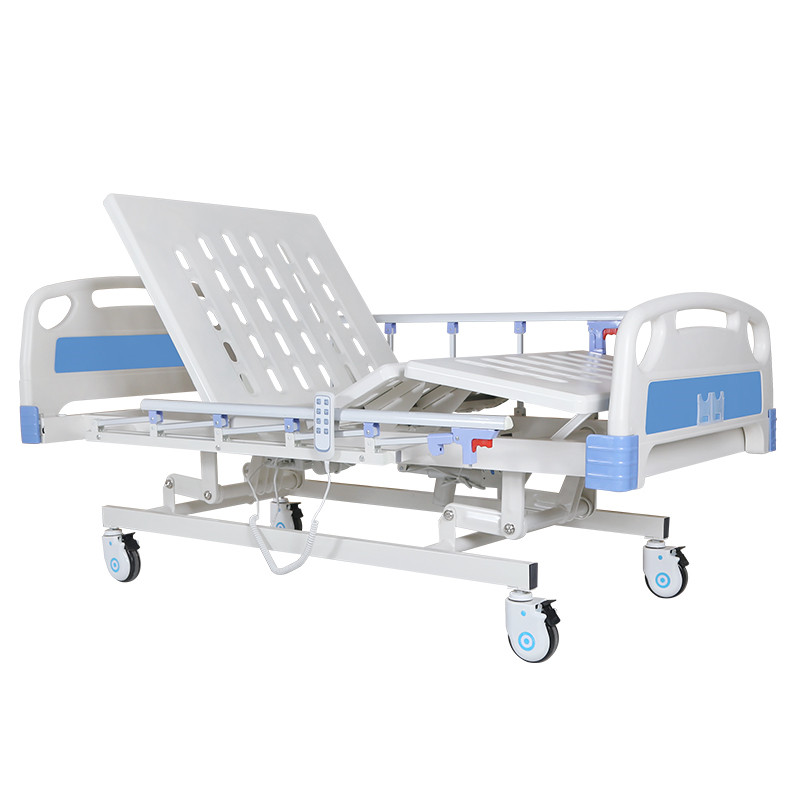
- Electric three-function hospital beds
- Electric five-function ICU hospital beds
- Manual two-crank hospital beds
- Manual three-crank hospital beds
- Dedicated IV pole mounting sockets
- Removable infusion stand options
- Model-specific stainless steel IV pole configurations
- Different side rail and braking systems
- ABS or PP headboards and footboards
- Compatible mattresses and medical accessories
Not every hospital bed includes the same number of mounting sockets or identical accessories. Buyers should confirm the actual configuration before ordering.
Explore our hospital bed product range to compare available models and configurations.
For other compatible medical furniture and equipment, visit our medical accessories collection.
Frequently Asked Questions About Hospital Bed IV Pole Mounting
Do all hospital beds include an IV pole?
No. Some models include an IV pole in their standard configuration, while others provide it as an optional accessory. Buyers should confirm the quotation details.
Can an IV pole be installed at either end of the bed?
This depends on the mounting socket arrangement of the selected model. Only manufacturer-approved mounting positions should be used.
Are hospital bed IV pole sockets universal?
No. Socket dimensions and mounting structures vary between bed manufacturers and models. Compatibility should be verified before installation.
Can an IV pole be used while the bed height changes?
This depends on the product's intended use, mounting position and approved accessory arrangement. The complete system must be used according to the manufacturer's instructions.
Can replacement IV poles be ordered separately?
Compatible replacement accessories may be available for selected models. Buyers should provide the exact hospital bed model and component specifications.
The IV Pole Connection Is a Small but Important Hospital Bed Detail
A hospital bed with an IV pole should be evaluated as a complete product configuration rather than a bed supplied with an unrelated accessory.
The mounting sockets, supporting brackets, removable pole, adjustment system and surrounding bed structures must be compatible with one another.
For hospitals and medical equipment distributors, confirming these details helps establish a clearer purchasing specification and reduces the risk of accessory compatibility problems.
HEYUAN supplies medical hospital beds and related accessories for international healthcare projects.
For product specifications, accessory configurations, OEM/ODM requirements or FOB Tianjin quotations, contact HEYUAN with your required model, quantity and destination market.