

Electric hospital beds are often introduced by the number of functions they offer, but that number alone does not tell a buyer whether the bed is right for a real project. A two-function bed, a three-function bed, a five-function bed, and an ICU-style model may all look similar in a quick catalog review. In daily use, however, each configuration serves a different care environment, budget level, maintenance plan, and user habit. For B2B buyers, the better question is not simply how many functions the bed has. The better question is which functions will create practical value for a hospital, nursing home, distributor channel, or medical equipment project.
This guide is written for purchasing managers, medical equipment distributors, hospital project contractors, care home operators, and importers who need to evaluate electric patient care beds before placing an order. It explains the main functions found in modern electric beds, where each function is useful, and how buyers can avoid paying for features that their customers may not need. It also connects function selection with component quality, control systems, accessories, inspection, packaging, and after-sales support.
Why Function Selection Matters in B2B Procurement
In many quotations, electric bed functions are presented in a short line: backrest, legrest, height adjustment, Trendelenburg, reverse Trendelenburg, or lateral tilt. These terms are useful, but they can hide important details. What is the adjustment angle? How smooth is the movement under load? How many motors are used? Can caregivers lock certain controls? Is the handset easy to understand? Does the bed remain stable at the highest position? These details affect the final user experience more than the function count alone.
Function selection also influences price, shipping weight, spare parts inventory, and service risk. A distributor selling to basic clinics may need a simple electric bed that is affordable and easy to repair. A private hospital may prefer a more complete configuration with stronger positioning and better patient comfort. A nursing home may value low height and quiet movement more than advanced clinical angles. An ICU project may require higher stability, emergency access, and more careful component review.
When buyers select functions carefully, they can build a product line that makes sense. Instead of offering one vague electric hospital bed to every customer, they can prepare several clear options: a standard ward bed, a nursing care bed, a premium private-room model, and a higher-spec bed for intensive or special care use. This structure helps sales teams explain value and helps purchasing teams compare suppliers more accurately.
Backrest Adjustment: The Function Used Every Day
Backrest adjustment is one of the most frequently used functions on an electric hospital bed. It helps patients sit up for meals, communication, breathing comfort, reading, and basic care activities. In hospitals and nursing homes, this function is used many times each day, so movement smoothness and motor reliability are important. A bed with weak backrest movement may pass a quick test when empty, but perform poorly when used by heavier patients or after several months of operation.
For B2B buyers, the backrest angle should be confirmed in the specification. Many beds offer a maximum angle around 70 degrees, but the exact range can vary. Buyers should also check whether the back section moves smoothly without sudden jerks or loud noise. If the bed is intended for elderly care, the movement should feel calm and controlled. Sudden movement may make users uncomfortable even if the motor technically works.
Backrest structure is also worth reviewing. The platform should support the mattress evenly and avoid creating uncomfortable pressure points. If the bed will be paired with an anti-bedsore air mattress, the buyer should confirm that the mattress bends properly with the backrest section. A mismatch between bed movement and mattress design can reduce comfort and create complaints for distributors.
Legrest and Knee Adjustment: Comfort and Positioning
Legrest or knee adjustment is often paired with backrest movement. In a three-function electric bed, it helps improve positioning and comfort, especially when patients spend long hours in bed. For nursing homes and rehabilitation facilities, this function can support sitting posture and reduce sliding when the backrest is raised. For hospital wards, it gives caregivers more flexibility during routine care.
Buyers should ask whether the leg section moves as a simple knee break or as a more controlled legrest system. The structure should hold position firmly and return smoothly. If the leg section feels unstable, it may become a weak point after repeated use. For distributors, this detail matters because end users often judge bed quality by the feeling of movement, not by the written specification.
For lower-budget projects, some buyers may consider a two-function bed with backrest and legrest adjustment but without electric height adjustment. This can be suitable for certain home care or basic nursing environments, but the buyer should understand the trade-off. Without height adjustment, caregiver ergonomics and patient transfer may be less convenient. The decision depends on the customer's care workflow and budget.
Height Adjustment: A Key Function for Caregiver Efficiency
Height adjustment is one of the most important differences between a basic electric bed and a more practical hospital or care facility bed. Raising the bed can help caregivers work at a more comfortable height during cleaning, repositioning, and basic treatment. Lowering the bed can help with patient transfer and may be useful in elderly care settings. In many facilities, height adjustment affects staff workload every day.
When reviewing height adjustment, buyers should check the minimum and maximum height, lifting stability, motor strength, and movement noise. A low minimum height may be attractive for nursing homes, while a higher working height may be useful in hospital wards. If the bed shakes at its highest position, the buyer should treat that as a serious quality warning. Stability is especially important when the bed is moved, cleaned, or used with accessories.
Buyers should also compare scissor lift, column lift, and other lifting structures when available. The best structure depends on the model and price level, but the same inspection principle applies: the bed should rise and lower evenly, remain stable under load, and allow easy cleaning around the base. If the project requires frequent bed movement, caster and brake quality should be evaluated together with height adjustment.
Trendelenburg and Reverse Trendelenburg
Trendelenburg and reverse Trendelenburg positioning are common in higher-function electric hospital beds. These movements tilt the entire bed surface head-down or foot-down. They may be useful in certain clinical environments, but they are not required for every project. Buyers should avoid assuming that more functions automatically mean a better purchasing decision. A nursing home, for example, may not need these features if its main needs are comfort, low height, and easy operation.
For hospitals and special care environments, these functions may be valuable. The buyer should confirm the tilt angle, control method, safety limit, and structural stability. If the bed is tilted under load, the frame, side rails, casters, and brakes must all feel secure. The control system should also prevent accidental operation where necessary. In some cases, a nurse control panel or lockout function may be required.
Distributors should position these functions carefully in their catalog. They can be a strong selling point for advanced models, but they may increase cost and maintenance complexity. A clear product line can help: standard beds for general wards, more advanced beds for hospitals that require clinical positioning, and separate nursing care beds for long-term care environments.
Lateral Tilt and Turning Functions
Some electric beds include lateral tilt or turning functions. These features may support repositioning and caregiver work in certain settings, but they should be evaluated with care. A turning function sounds attractive in a catalog, yet buyers need to check whether the mechanism is stable, easy to control, and suitable for the intended patient group. In elderly care, movement should feel gentle and predictable. In a hospital, staff may need clear control authority and reliable locking.
Because lateral movement adds mechanical complexity, buyers should ask for detailed videos, sample testing, or factory demonstrations before ordering in volume. Check whether the mattress stays in position, whether side rails remain safe, and whether cables are protected. Also ask about spare parts. If the function depends on special hardware that is difficult to replace, after-sales service may become harder for importers and distributors.
For many buyers, lateral tilt should be offered as a specialized configuration, not a default choice. It may fit certain care projects, but a well-built three-function or five-function bed may be more practical for broader markets.
Handsets, Nurse Controls, and Lockout Functions
The control system is where users interact with the bed every day. A handset should be clear, durable, and easy to understand. Symbols should be intuitive for international users. Buttons should have a firm feel, and the cable should be protected from pulling or bending. A low-quality handset can make an otherwise acceptable bed feel unreliable.
Some hospital beds include nurse control panels or lockout functions. These allow caregivers to limit patient access to certain movements. This can be useful in hospitals and care environments where safety control is important. For home care or basic nursing beds, a simpler handset may be enough. Buyers should match the control system to the user environment instead of adding cost without a clear purpose.
Power supply details should be confirmed early. Voltage, plug type, battery backup options, cable length, and emergency lowering method may differ by market. A distributor should not wait until goods arrive to discover that the plug type is unsuitable. These are small details, but they affect customer confidence.
Motors and Component Quality
Motors are central to electric bed reliability. Buyers should ask about motor quantity, rated load, noise level, duty cycle, protection level where relevant, and replacement availability. A supplier may not always use a famous international brand, but it should be able to explain the motor specification and provide consistent parts. Consistency is especially important for distributors who plan repeat orders.
Component quality includes more than motors. Side rail locks, caster brakes, headboard fittings, IV pole sockets, mattress stoppers, and cable clips all affect daily use. These items may not look expensive, but weak small parts create many after-sales complaints. A complete quotation should state standard accessories clearly, and optional items should be listed separately.
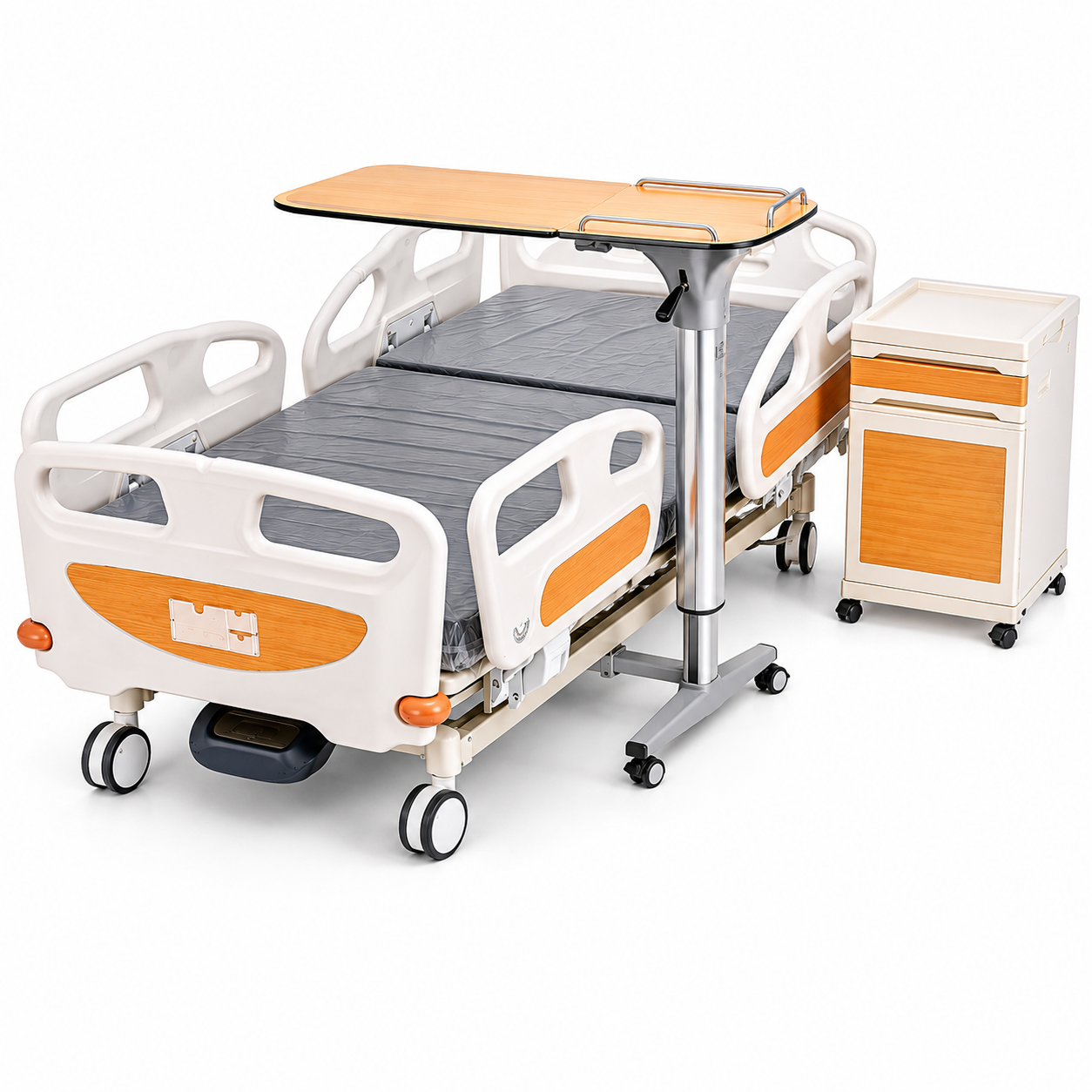
If the buyer also purchases medical bed accessories, compatibility should be checked before shipment. IV poles, bedside cabinets, mattresses, overbed tables, and oxygen bottle holders need to work with the bed model. A complete product package is useful, but only if the parts fit together properly.
Matching Functions to Project Types
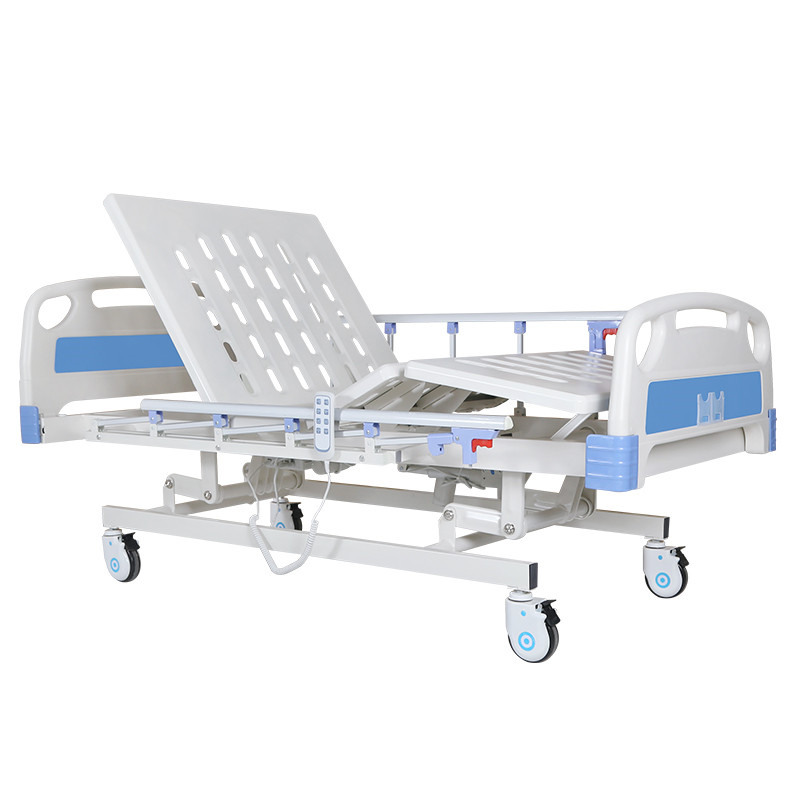
For general hospital wards, a three-function electric hospital bed is often a practical choice. It usually covers backrest, legrest, and height adjustment. This configuration supports daily care without becoming too expensive or complex. Buyers should focus on frame strength, smooth movement, easy cleaning, side rail quality, and caster brakes.
For private hospitals and premium wards, a five-function bed may be more attractive. Trendelenburg and reverse Trendelenburg can add clinical positioning flexibility, and better boards or rails can improve room appearance. The buyer should confirm whether the extra functions are actually needed by the facility and whether the budget supports higher component quality.
For nursing homes and long-term care projects, comfort, low height, quiet movement, warm appearance, and simple operation are often more important than advanced clinical angles. Matching bedside furniture, such as a hospital bedside table, can also make the room solution more complete. For distributors, the best approach is usually to build a small but clear range: one basic manual or semi-electric option, one standard three-function electric bed, one higher-spec model, and one nursing care model.
Inspection Points Before Confirming an Order
Before placing a volume order, buyers should prepare a practical inspection checklist. It should include bed dimensions, function angles, motor operation, noise, handset response, side rail locking, caster braking, board installation, coating finish, accessory quantity, labels, manuals, packaging, and carton marks. For electric beds, each movement should be tested under realistic conditions.
Packaging should be checked with the same seriousness as the bed itself. Electric hospital beds are large and heavy. If packaging is weak, boards can scratch, casters can break, and accessories can go missing. Ask for packing photos, carton size, gross weight, loading quantity, and whether the packaging is suitable for container loading or mixed shipments. Good packaging protects both the product and the buyer's reputation.
For new suppliers, samples or detailed function videos are valuable. If a sample is too costly, request close-up videos of movement, rails, casters, motors, and packing. Buyers can also review the manufacturer's factory capability to understand production and assembly background before confirming long-term cooperation.
RFQ Details Buyers Should Include
A clear RFQ helps the supplier quote the right configuration from the beginning. Buyers should state the bed type, required functions, bed platform size, safe working load, side rail preference, headboard and footboard material, caster requirement, motor voltage, plug type, handset type, mattress requirement, accessory package, packing method, destination port, and expected order quantity. If the project has a tender document, reference photo, or room layout, those files should be shared before the quotation is finalized.
It is also useful to separate must-have requirements from optional upgrades. For example, height adjustment may be essential for a hospital ward, while Trendelenburg may be optional. A nurse control panel may be required for one project but unnecessary for a basic distributor stock model. This distinction helps the supplier prepare two or three accurate options instead of one unclear quotation. It also helps the buyer explain the final choice to managers, engineers, or end customers.
For repeat business, buyers should ask whether the selected model can remain stable for future orders. Changing motors, rails, colors, or accessories too often can make spare parts and local marketing difficult. A stable model with clear documentation is easier to sell, service, and reorder.
After-Sales Planning for Distributors
After-sales planning should begin before the first shipment. A distributor needs spare handsets, motors, side rail parts, casters, and small fittings in a reasonable quantity. The supplier should provide parts codes, basic troubleshooting guidance, and clear warranty rules. If a product line becomes popular, repeat orders will be easier when the same parts and specifications remain stable over time.
Training is also part of after-sales service. Sales teams should understand how to explain functions honestly, and service teams should know which issues can be solved locally. A simple video showing handset operation, side rail locking, caster braking, and motor replacement can reduce many avoidable service calls. For B2B buyers, these small support materials can make a supplier more valuable than a slightly lower price.
Conclusion
Choosing electric hospital bed functions is a practical business decision. More functions are not always better, and fewer functions are not always enough. The right configuration depends on the care environment, user habits, budget, maintenance plan, and sales channel. B2B buyers should compare real specifications, not only catalog names.
A good electric bed should move smoothly, feel stable, use reliable components, match the correct accessories, and fit the end customer's daily workflow. When buyers define the project clearly and communicate detailed requirements to the supplier, quotations become easier to compare and product quality becomes easier to control. For project discussions, model recommendations, or configuration details, buyers can contact the sales team with their target market, quantity, and required functions.
How B2B Buyers Should Choose Electric Hospital Bed Functions for Different Care Projects
Electric hospital beds are often introduced by the number of functions they offer, but that number alone does not tell a buyer whether the bed is right for a real project. A two-function bed, a three-function bed, a five-function bed, and an ICU-style model may all look similar in a quick catalog review. In daily use, however, each configuration serves a different care environment, budget level, maintenance plan, and user habit. For B2B buyers, the better question is not simply how many functions the bed has. The better question is which functions will create practical value for a hospital, nursing home, distributor channel, or medical equipment project.
This guide is written for purchasing managers, medical equipment distributors, hospital project contractors, care home operators, and importers who need to evaluate electric patient care beds before placing an order. It explains the main functions found in modern electric beds, where each function is useful, and how buyers can avoid paying for features that their customers may not need. It also connects function selection with component quality, control systems, accessories, inspection, packaging, and after-sales support.
Why Function Selection Matters in B2B Procurement
In many quotations, electric bed functions are presented in a short line: backrest, legrest, height adjustment, Trendelenburg, reverse Trendelenburg, or lateral tilt. These terms are useful, but they can hide important details. What is the adjustment angle? How smooth is the movement under load? How many motors are used? Can caregivers lock certain controls? Is the handset easy to understand? Does the bed remain stable at the highest position? These details affect the final user experience more than the function count alone.
Function selection also influences price, shipping weight, spare parts inventory, and service risk. A distributor selling to basic clinics may need a simple electric bed that is affordable and easy to repair. A private hospital may prefer a more complete configuration with stronger positioning and better patient comfort. A nursing home may value low height and quiet movement more than advanced clinical angles. An ICU project may require higher stability, emergency access, and more careful component review.
When buyers select functions carefully, they can build a product line that makes sense. Instead of offering one vague electric hospital bed to every customer, they can prepare several clear options: a standard ward bed, a nursing care bed, a premium private-room model, and a higher-spec bed for intensive or special care use. This structure helps sales teams explain value and helps purchasing teams compare suppliers more accurately.
Backrest Adjustment: The Function Used Every Day
Backrest adjustment is one of the most frequently used functions on an electric hospital bed. It helps patients sit up for meals, communication, breathing comfort, reading, and basic care activities. In hospitals and nursing homes, this function is used many times each day, so movement smoothness and motor reliability are important. A bed with weak backrest movement may pass a quick test when empty, but perform poorly when used by heavier patients or after several months of operation.
For B2B buyers, the backrest angle should be confirmed in the specification. Many beds offer a maximum angle around 70 degrees, but the exact range can vary. Buyers should also check whether the back section moves smoothly without sudden jerks or loud noise. If the bed is intended for elderly care, the movement should feel calm and controlled. Sudden movement may make users uncomfortable even if the motor technically works.
Backrest structure is also worth reviewing. The platform should support the mattress evenly and avoid creating uncomfortable pressure points. If the bed will be paired with an anti-bedsore air mattress, the buyer should confirm that the mattress bends properly with the backrest section. A mismatch between bed movement and mattress design can reduce comfort and create complaints for distributors.
Legrest and Knee Adjustment: Comfort and Positioning
Legrest or knee adjustment is often paired with backrest movement. In a three-function electric bed, it helps improve positioning and comfort, especially when patients spend long hours in bed. For nursing homes and rehabilitation facilities, this function can support sitting posture and reduce sliding when the backrest is raised. For hospital wards, it gives caregivers more flexibility during routine care.
Buyers should ask whether the leg section moves as a simple knee break or as a more controlled legrest system. The structure should hold position firmly and return smoothly. If the leg section feels unstable, it may become a weak point after repeated use. For distributors, this detail matters because end users often judge bed quality by the feeling of movement, not by the written specification.
For lower-budget projects, some buyers may consider a two-function bed with backrest and legrest adjustment but without electric height adjustment. This can be suitable for certain home care or basic nursing environments, but the buyer should understand the trade-off. Without height adjustment, caregiver ergonomics and patient transfer may be less convenient. The decision depends on the customer's care workflow and budget.
Height Adjustment: A Key Function for Caregiver Efficiency
Height adjustment is one of the most important differences between a basic electric bed and a more practical hospital or care facility bed. Raising the bed can help caregivers work at a more comfortable height during cleaning, repositioning, and basic treatment. Lowering the bed can help with patient transfer and may be useful in elderly care settings. In many facilities, height adjustment affects staff workload every day.
When reviewing height adjustment, buyers should check the minimum and maximum height, lifting stability, motor strength, and movement noise. A low minimum height may be attractive for nursing homes, while a higher working height may be useful in hospital wards. If the bed shakes at its highest position, the buyer should treat that as a serious quality warning. Stability is especially important when the bed is moved, cleaned, or used with accessories.
Buyers should also compare scissor lift, column lift, and other lifting structures when available. The best structure depends on the model and price level, but the same inspection principle applies: the bed should rise and lower evenly, remain stable under load, and allow easy cleaning around the base. If the project requires frequent bed movement, caster and brake quality should be evaluated together with height adjustment.
Trendelenburg and Reverse Trendelenburg
Trendelenburg and reverse Trendelenburg positioning are common in higher-function electric hospital beds. These movements tilt the entire bed surface head-down or foot-down. They may be useful in certain clinical environments, but they are not required for every project. Buyers should avoid assuming that more functions automatically mean a better purchasing decision. A nursing home, for example, may not need these features if its main needs are comfort, low height, and easy operation.
For hospitals and special care environments, these functions may be valuable. The buyer should confirm the tilt angle, control method, safety limit, and structural stability. If the bed is tilted under load, the frame, side rails, casters, and brakes must all feel secure. The control system should also prevent accidental operation where necessary. In some cases, a nurse control panel or lockout function may be required.
Distributors should position these functions carefully in their catalog. They can be a strong selling point for advanced models, but they may increase cost and maintenance complexity. A clear product line can help: standard beds for general wards, more advanced beds for hospitals that require clinical positioning, and separate nursing care beds for long-term care environments.
Lateral Tilt and Turning Functions
Some electric beds include lateral tilt or turning functions. These features may support repositioning and caregiver work in certain settings, but they should be evaluated with care. A turning function sounds attractive in a catalog, yet buyers need to check whether the mechanism is stable, easy to control, and suitable for the intended patient group. In elderly care, movement should feel gentle and predictable. In a hospital, staff may need clear control authority and reliable locking.
Because lateral movement adds mechanical complexity, buyers should ask for detailed videos, sample testing, or factory demonstrations before ordering in volume. Check whether the mattress stays in position, whether side rails remain safe, and whether cables are protected. Also ask about spare parts. If the function depends on special hardware that is difficult to replace, after-sales service may become harder for importers and distributors.
For many buyers, lateral tilt should be offered as a specialized configuration, not a default choice. It may fit certain care projects, but a well-built three-function or five-function bed may be more practical for broader markets.
Handsets, Nurse Controls, and Lockout Functions
The control system is where users interact with the bed every day. A handset should be clear, durable, and easy to understand. Symbols should be intuitive for international users. Buttons should have a firm feel, and the cable should be protected from pulling or bending. A low-quality handset can make an otherwise acceptable bed feel unreliable.
Some hospital beds include nurse control panels or lockout functions. These allow caregivers to limit patient access to certain movements. This can be useful in hospitals and care environments where safety control is important. For home care or basic nursing beds, a simpler handset may be enough. Buyers should match the control system to the user environment instead of adding cost without a clear purpose.
Power supply details should be confirmed early. Voltage, plug type, battery backup options, cable length, and emergency lowering method may differ by market. A distributor should not wait until goods arrive to discover that the plug type is unsuitable. These are small details, but they affect customer confidence.
Motors and Component Quality
Motors are central to electric bed reliability. Buyers should ask about motor quantity, rated load, noise level, duty cycle, protection level where relevant, and replacement availability. A supplier may not always use a famous international brand, but it should be able to explain the motor specification and provide consistent parts. Consistency is especially important for distributors who plan repeat orders.
Component quality includes more than motors. Side rail locks, caster brakes, headboard fittings, IV pole sockets, mattress stoppers, and cable clips all affect daily use. These items may not look expensive, but weak small parts create many after-sales complaints. A complete quotation should state standard accessories clearly, and optional items should be listed separately.
If the buyer also purchases medical bed accessories, compatibility should be checked before shipment. IV poles, bedside cabinets, mattresses, overbed tables, and oxygen bottle holders need to work with the bed model. A complete product package is useful, but only if the parts fit together properly.
Matching Functions to Project Types
For general hospital wards, a three-function electric hospital bed is often a practical choice. It usually covers backrest, legrest, and height adjustment. This configuration supports daily care without becoming too expensive or complex. Buyers should focus on frame strength, smooth movement, easy cleaning, side rail quality, and caster brakes.
For private hospitals and premium wards, a five-function bed may be more attractive. Trendelenburg and reverse Trendelenburg can add clinical positioning flexibility, and better boards or rails can improve room appearance. The buyer should confirm whether the extra functions are actually needed by the facility and whether the budget supports higher component quality.
For nursing homes and long-term care projects, comfort, low height, quiet movement, warm appearance, and simple operation are often more important than advanced clinical angles. Matching bedside furniture, such as a hospital bedside table, can also make the room solution more complete. For distributors, the best approach is usually to build a small but clear range: one basic manual or semi-electric option, one standard three-function electric bed, one higher-spec model, and one nursing care model.
Inspection Points Before Confirming an Order
Before placing a volume order, buyers should prepare a practical inspection checklist. It should include bed dimensions, function angles, motor operation, noise, handset response, side rail locking, caster braking, board installation, coating finish, accessory quantity, labels, manuals, packaging, and carton marks. For electric beds, each movement should be tested under realistic conditions.
Packaging should be checked with the same seriousness as the bed itself. Electric hospital beds are large and heavy. If packaging is weak, boards can scratch, casters can break, and accessories can go missing. Ask for packing photos, carton size, gross weight, loading quantity, and whether the packaging is suitable for container loading or mixed shipments. Good packaging protects both the product and the buyer's reputation.
For new suppliers, samples or detailed function videos are valuable. If a sample is too costly, request close-up videos of movement, rails, casters, motors, and packing. Buyers can also review the manufacturer's factory capability to understand production and assembly background before confirming long-term cooperation.
RFQ Details Buyers Should Include
A clear RFQ helps the supplier quote the right configuration from the beginning. Buyers should state the bed type, required functions, bed platform size, safe working load, side rail preference, headboard and footboard material, caster requirement, motor voltage, plug type, handset type, mattress requirement, accessory package, packing method, destination port, and expected order quantity. If the project has a tender document, reference photo, or room layout, those files should be shared before the quotation is finalized.
It is also useful to separate must-have requirements from optional upgrades. For example, height adjustment may be essential for a hospital ward, while Trendelenburg may be optional. A nurse control panel may be required for one project but unnecessary for a basic distributor stock model. This distinction helps the supplier prepare two or three accurate options instead of one unclear quotation. It also helps the buyer explain the final choice to managers, engineers, or end customers.
For repeat business, buyers should ask whether the selected model can remain stable for future orders. Changing motors, rails, colors, or accessories too often can make spare parts and local marketing difficult. A stable model with clear documentation is easier to sell, service, and reorder.
After-Sales Planning for Distributors
After-sales planning should begin before the first shipment. A distributor needs spare handsets, motors, side rail parts, casters, and small fittings in a reasonable quantity. The supplier should provide parts codes, basic troubleshooting guidance, and clear warranty rules. If a product line becomes popular, repeat orders will be easier when the same parts and specifications remain stable over time.
Training is also part of after-sales service. Sales teams should understand how to explain functions honestly, and service teams should know which issues can be solved locally. A simple video showing handset operation, side rail locking, caster braking, and motor replacement can reduce many avoidable service calls. For B2B buyers, these small support materials can make a supplier more valuable than a slightly lower price.
Conclusion
Choosing electric hospital bed functions is a practical business decision. More functions are not always better, and fewer functions are not always enough. The right configuration depends on the care environment, user habits, budget, maintenance plan, and sales channel. B2B buyers should compare real specifications, not only catalog names.
A good electric bed should move smoothly, feel stable, use reliable components, match the correct accessories, and fit the end customer's daily workflow. When buyers define the project clearly and communicate detailed requirements to the supplier, quotations become easier to compare and product quality becomes easier to control. For project discussions, model recommendations, or configuration details, buyers can contact the sales team with their target market, quantity, and required functions.