

Introduction: Why Patient Care Bed Purchasing Needs a More Practical Specification
For hospitals, nursing homes, rehabilitation centers, distributors, and medical project contractors, a patient care bed is not a simple furniture purchase. It is part of a working care environment. It affects patient positioning, caregiver efficiency, room layout, cleaning routines, maintenance budgets, spare parts planning, and the long-term reputation of the buyer. A low initial price may look attractive during quotation comparison, yet the real cost appears later through unstable motors, weak guardrails, poor packaging, delayed spare parts, or products that do not match local user expectations.
Many international buyers begin with a simple request such as “send me your hospital bed price.” That is understandable when a project is urgent, but it often leads to unclear offers. One supplier may quote a basic manual bed with limited accessories, another may quote a three-function electric hospital bed, and a third may include a mattress, IV pole, overbed table, and wooden headboard. Without a clear procurement specification, the buyer is not comparing the same product. The result can be slow negotiation, repeated samples, and unexpected cost after the order is placed.
This guide is written for B2B buyers who need a more reliable way to purchase patient care beds from overseas manufacturers. It focuses on the practical details that affect decision-making: bed functions, materials, dimensions, safety structure, accessories, packaging, quality inspection, supplier capability, and total cost. It is especially useful for distributors preparing a product line, hospitals planning a ward upgrade, nursing homes building new rooms, and importers evaluating a medical bed manufacturer in China or another production market.
1. Define the Use Scenario Before Comparing Prices
The first question is not whether the bed should be cheap or expensive. The first question is where and how the bed will be used. A patient care bed for a general hospital ward has different priorities from a home care nursing bed used by elderly people. An ICU bed may require stronger movement control, higher stability, and more accessories. A nursing home bed may require warmer visual design, lower height, easier cleaning, and safer side rail operation. A rehabilitation center may care more about transfer support and daily positioning.
For distributors, use scenarios are even more important because the product must fit the local sales channel. A distributor selling to public hospitals may need robust electric beds with standard medical appearance, while a distributor selling to private care homes may need a more residential design. A tender project may require exact specifications, documents, and model consistency. A retail-oriented home care channel may require packaging that can survive smaller mixed shipments and clearer assembly instructions.
Before requesting a quotation, buyers should separate demand into categories. These may include general ward beds, electric hospital beds, manual hospital beds, home care nursing beds, ICU beds, pediatric or specialty beds, and related accessories. Each category should have its own function requirements, target price range, expected order volume, and after-sales expectation. This simple step usually saves time because the supplier can recommend a suitable model instead of sending a large catalog with no purchasing direction.
2. Decide Between Manual, Semi-Electric, and Fully Electric Beds
Patient care beds are commonly divided by control method. Manual beds use hand cranks to adjust backrest, leg section, and sometimes bed height. Semi-electric beds may combine electric backrest or leg adjustment with manual height control. Fully electric beds use motors and a handset or control panel to adjust the main positions. Each option has a place in B2B procurement, and the best choice depends on user environment, labor cost, maintenance resources, and project budget.
Manual hospital beds remain popular in cost-sensitive projects, field hospitals, basic clinics, and regions where simple maintenance is preferred. Their advantages are lower purchase cost, fewer electrical parts, and easier repair by local technicians. However, they require more caregiver effort. In facilities with a high patient turnover or limited staff, manual adjustment can become inefficient. Buyers should not judge manual beds only by price; crank quality, screw mechanism smoothness, welding, caster strength, and bed platform stability still matter.
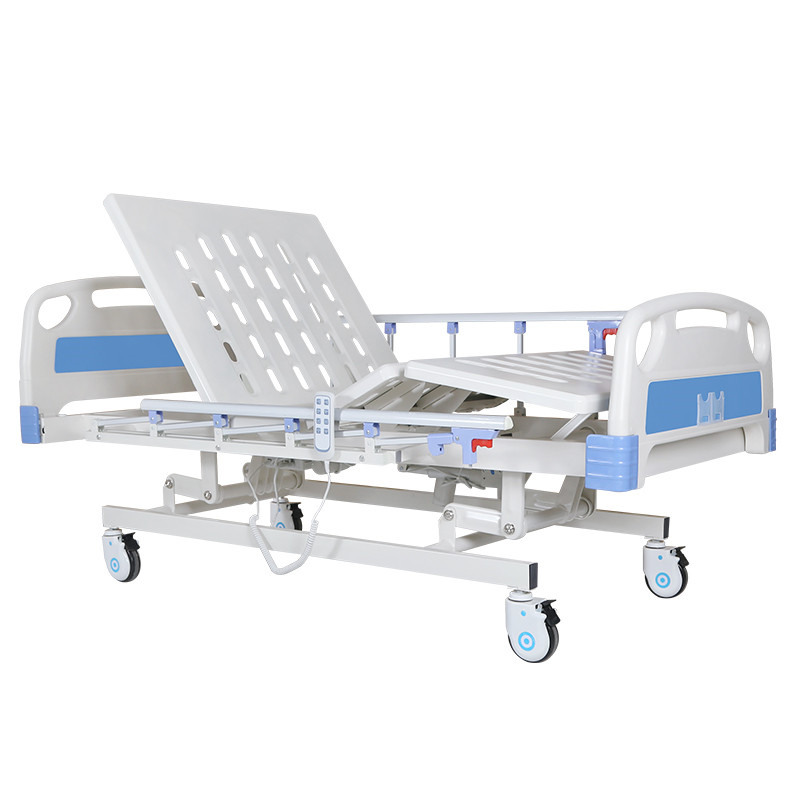
Electric hospital beds are often preferred for modern wards, private hospitals, rehabilitation centers, and higher-end nursing facilities. They support more convenient positioning and reduce physical effort for caregivers. For B2B buyers, the key is to review the motor brand or motor specification, control logic, emergency lowering method, power supply compatibility, cable protection, and availability of replacement parts. A cheaper electric bed with unstable electronics can become more expensive than a well-built model once service calls and complaints are included.
Semi-electric beds can be a useful middle choice. They offer convenience where it matters most while keeping cost lower than full electric models. For some care homes, electric backrest adjustment is enough because residents use it daily for sitting, eating, or reading. Height adjustment may be less frequent and can remain manual. This type of balance is worth discussing with the supplier, especially when the buyer needs to build a competitive product line for different customer budgets.
3. Understand the Core Functions Buyers Usually Compare
Most patient care bed quotations mention two-function, three-function, five-function, or multi-function models. The exact meaning can vary by supplier, so buyers should ask for a clear function table. Common functions include backrest adjustment, leg or knee section adjustment, overall height adjustment, Trendelenburg and reverse Trendelenburg positioning, lateral tilt, cardiac chair position, and bed extension. Not every project needs every function. More functions can increase cost, weight, maintenance complexity, and training requirements.
For general wards, a three-function electric hospital bed is often sufficient: backrest, leg section, and height adjustment. For nursing homes, backrest and knee adjustment are important for comfort, while low height may be useful for fall risk management. For ICU applications, functions may be more advanced and need closer review. Buyers should ask whether each function is controlled by separate motors, what the adjustment angles are, and whether the movement remains stable under load.
It is also important to check how functions behave in daily use. Does the handset feel clear and durable? Are symbols easy to understand for international users? Is there a nurse control panel or locking function? Can the bed be operated safely by elderly users in home care settings? Are cables placed where they will not be caught by moving parts? These details may not appear in a short quotation, but they affect satisfaction after delivery.
4. Review Bed Frame Materials, Welding, and Surface Treatment
The bed frame is the foundation of product durability. Most hospital and nursing beds use steel structure with powder coating, while some models include ABS, PP, aluminum alloy, stainless steel, or wooden elements. The buyer should ask about frame thickness, platform material, welding quality, load capacity, and anti-rust treatment. A patient care bed may look similar in a photo, but the structure can be very different once inspected closely.
Powder coating quality deserves attention. In humid climates or coastal regions, poor surface treatment can lead to corrosion. For distributors, this becomes a brand problem because customers rarely separate the distributor from the manufacturer. Ask suppliers about pre-treatment process, coating thickness, and whether samples have smooth edges and consistent finish. Sharp edges, uneven coating, and rough welds are warning signs, especially for medical environments where cleaning and safety are important.
The platform design also matters. Some beds use punched steel panels, some use steel slats, and some use ABS platforms. Buyers should consider cleaning, mattress ventilation, strength, replacement cost, and local preferences. In hospitals, easy disinfection and long-term durability are usually important. In home care and nursing homes, comfort, appearance, and noise control may carry more weight. The best choice is not always the heaviest structure; it is the structure that fits the use case and can be supplied consistently.
5. Check Side Rails, Headboards, Footboards, and Patient Transfer Details
Side rails are one of the most visible safety-related components of a patient care bed. Buyers should check rail height, locking mechanism, release method, material, and ease of cleaning. Full-length rails, split rails, aluminum rails, ABS rails, and wooden-style rails all serve different markets. A hospital may prefer durable ABS or aluminum rails, while a nursing home may prefer a warmer design that reduces the institutional feel of the room.
Locking reliability should be tested on samples. A rail that feels loose, drops too quickly, or requires awkward operation may cause complaints. For international projects, users may not have the same training level as the manufacturer assumes. The operation should be intuitive. If the bed is for elderly care, the rail should support safe daily care without creating unnecessary difficulty for staff.
Headboards and footboards are also part of procurement quality. Removable boards help with emergency access and cleaning. ABS boards are common in hospital settings because they are lightweight and easy to wipe. Wooden-style boards can be more attractive in nursing homes and private care rooms. Buyers should ask whether boards are easy to install, whether the locking structure is firm, and whether replacement parts can be supplied separately.
Patient transfer details should not be ignored. Bed height range, caster quality, brake system, mattress platform width, and accessory hooks all influence transfer from bed to wheelchair, stretcher, or standing position. A bed that looks good in a catalog but is too high, too narrow, or difficult to brake may not fit the actual care workflow.
6. Evaluate Motors, Handsets, Casters, and Other Key Components
For electric patient care beds, the motor system is a major cost and quality factor. Buyers should ask about motor quantity, rated load, noise level, waterproof level where relevant, duty cycle, power input, certification documents, and spare motor availability. It is also useful to ask how cables are protected during bed movement. Cable damage is a common practical issue when design is poor or assembly is rushed.
The handset should be simple, durable, and suited to the buyer’s market. A handset with unclear icons may increase training time. A fragile handset can generate repeated after-sales issues. Some facilities need nurse lockout functions so patients cannot accidentally operate certain movements. Others may prefer simple controls to keep cost lower. The correct choice depends on user environment.
Casters are another small component with a large effect. A hospital bed may be moved regularly for cleaning, room changes, or patient transfer. Caster diameter, brake type, central locking option, wheel material, and floor compatibility should be reviewed. In many procurement cases, buyers focus on the bed frame and forget that poor casters can make a strong bed feel cheap. For project orders, caster requirements should be written clearly in the specification.
Other components include IV pole sockets, drainage hooks, mattress stoppers, bumper wheels, oxygen bottle holders, overbed table compatibility, and accessory rails. Buyers should decide which items are standard and which are optional. A clear accessory list prevents confusion when comparing supplier quotations.
7. Match Mattress and Accessories With the Bed, Not as an Afterthought
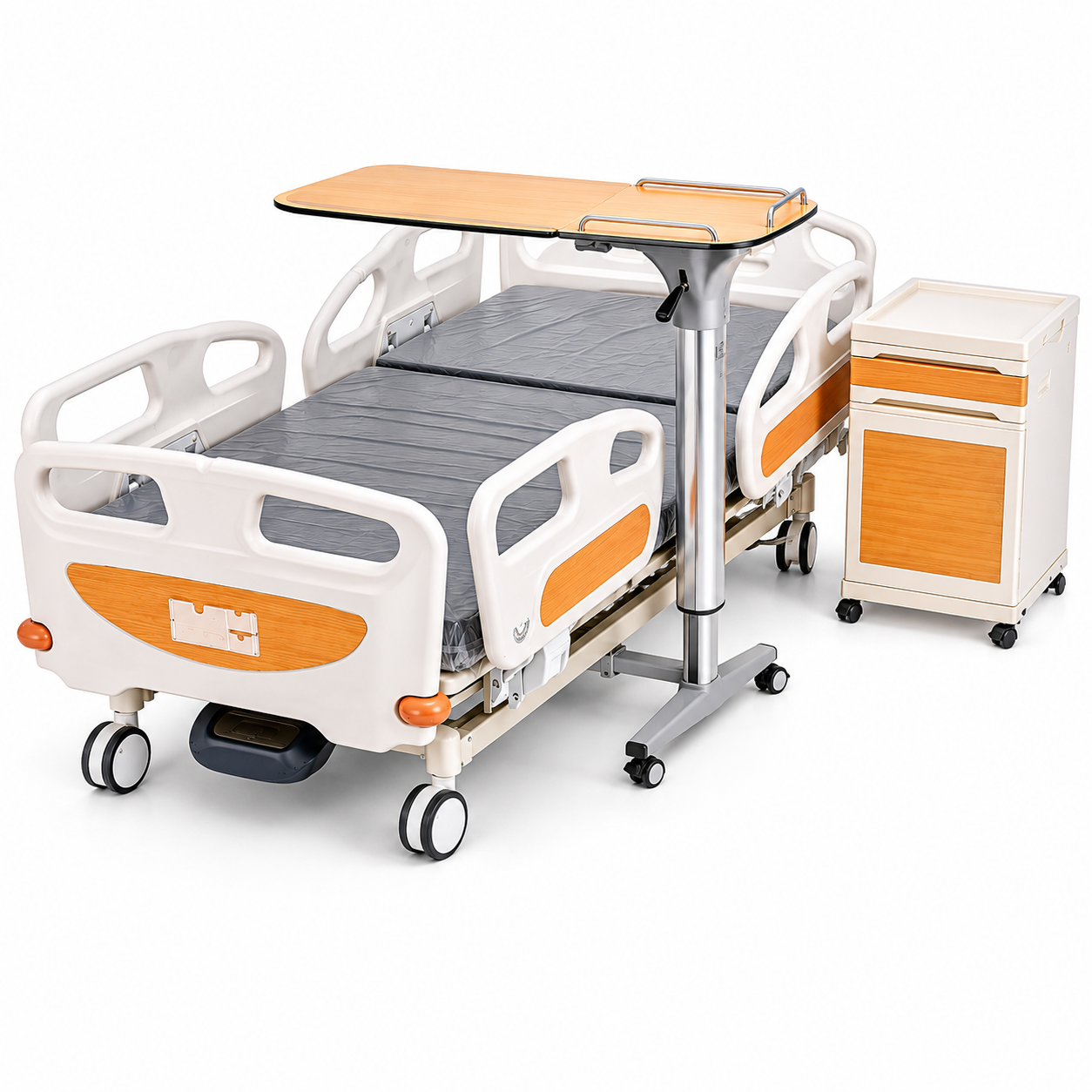
A patient care bed is often purchased together with a mattress, IV pole, bedside table, air mattress, or other accessories. These items should be checked as a system. Mattress size must match the bed platform. Mattress thickness should work with side rail height. If the buyer plans to sell anti-bedsore air mattresses, the bed frame should provide a stable and suitable platform. If the project includes hospital bedside tables, the design and height should match the care environment.
For distributors, accessory compatibility can become a useful sales advantage. A complete room solution is often easier to sell than a single bed, especially to nursing homes, clinics, and project contractors. However, this requires careful standardization. If each shipment uses different mattress dimensions or different accessory fittings, inventory becomes difficult. Buyers should ask suppliers to confirm repeatable specifications and provide spare parts lists.
When selecting mattresses, consider density, cover material, waterproof performance, cleaning method, fire requirements in the destination market, and packaging. For air mattresses, check pump voltage, plug type, noise, pressure range, and after-sales parts. Accessories may be lower value than the bed, but they can affect customer perception strongly because users interact with them every day.
8. Build a Supplier Evaluation Checklist
A reliable medical bed manufacturer should provide more than a price list. B2B buyers should evaluate production capability, quality control, export experience, communication speed, sample support, packaging design, document support, and spare parts policy. A supplier may have attractive photos but weak delivery control. Another supplier may be slightly more expensive but easier to work with over several years. For distributors and project buyers, cooperation stability is often worth more than the lowest unit price.
Ask about factory processes such as cutting, welding, polishing, powder coating, assembly, inspection, and packing. If the supplier can provide factory photos, production videos, inspection records, and product test information, the buyer can make a more informed decision. For large orders, a pre-shipment inspection plan should be discussed early. Inspection should cover appearance, function, accessories, labeling, packaging, and quantity.
Communication is also a quality signal. A professional supplier should ask questions before quoting: target market, use scenario, function requirement, order quantity, packaging method, voltage, plug standard, certification needs, and expected delivery time. If a supplier quotes immediately without understanding the project, the buyer may receive a number rather than a solution.
9. Compare Total Cost Instead of Unit Price Alone
Unit price is important, but it is only one part of patient care bed procurement. Total cost includes accessories, spare parts, packaging, inland transport, sea freight or air freight, customs clearance, import duties, local delivery, warranty handling, training, and possible replacement parts. A bed that is twenty dollars cheaper may cost more if the packaging is weak or if one container arrives with damaged boards and missing accessories.
Packaging deserves special attention for international shipping. Beds are heavy, large, and vulnerable to scratches or impact if not packed properly. Buyers should ask for packing photos, carton dimensions, gross weight, loading quantity, and whether the packaging is suitable for container loading or mixed shipment. If the buyer sells through distribution channels, packaging must also survive warehouse handling and local delivery.
Spare parts cost should be discussed before the first order. Motors, handsets, casters, side rail parts, headboards, and small fittings may be needed later. A good supplier can recommend a spare parts ratio for the first shipment. This helps distributors respond quickly to customer service needs. For hospitals and nursing homes, local spare parts availability reduces downtime.
10. Prepare a Clear RFQ for Faster and More Accurate Quotations
A professional request for quotation should include the intended use, preferred bed type, functions, dimensions, load capacity, material preferences, side rail type, headboard and footboard type, caster requirement, motor and voltage requirement, mattress and accessory needs, order quantity, packaging preference, destination port, certification or document needs, and target delivery schedule. If possible, attach photos or tender documents.
Buyers should also tell the supplier whether the project is for public tender, private hospital, distributor stock, nursing home project, or home care retail channel. This context helps the manufacturer recommend the right model and avoid over-specification. For example, a high-end electric bed may not fit a basic clinic tender, while a basic manual bed may not satisfy a private rehabilitation center.
When comparing quotations, create a table with the same fields for each supplier. Include product model, functions, material, accessories, warranty, packing size, loading quantity, lead time, payment terms, and spare parts policy. This makes the decision more objective. It also helps the buyer explain the choice internally to management, engineers, or purchasing committees.
11. Sample Orders and Pre-Shipment Inspection
For new suppliers, sample orders are useful when time and budget allow. A sample can reveal assembly quality, movement stability, noise, packaging, documentation, and communication accuracy. If a sample is not possible due to size or cost, buyers can request detailed videos showing each function, close-up photos of welding and components, packaging demonstration, and inspection reports.
Before mass shipment, inspection criteria should be agreed in writing. Basic checks include model number, quantity, appearance, dimensions, function operation, caster brakes, side rail locks, headboard and footboard installation, accessories, labels, user manual, carton marking, and packaging strength. For electric beds, inspectors should test every motor movement and check power plug specifications. Any defect classification should be clear: critical, major, and minor.
Inspection is not only about finding problems. It also creates a shared standard between buyer and supplier. When the supplier knows the buyer will check specific items, production teams are more likely to control those items carefully. For repeat orders, the inspection checklist becomes part of the long-term quality system.
12. After-Sales Planning for Distributors and Project Buyers
After-sales service begins before the order is shipped. Distributors should prepare user manuals, installation guidance, spare parts inventory, local service process, and warranty terms. Hospitals and care homes should identify who will maintain the beds, how to report problems, and which spare parts should be kept on site. A patient care bed is used daily, so small issues need quick solutions.
Ask the supplier for exploded diagrams, spare parts codes, motor replacement guidance, and troubleshooting steps. If possible, request short videos for common service tasks. This is especially useful for distributors training local technicians. The supplier should also clarify which parts are covered by warranty and how warranty claims are handled. Clear expectations reduce conflict later.
For long-term cooperation, buyers can track service data by model. If a certain component receives repeated complaints, the buyer and supplier can improve it together. This is one reason not to switch suppliers too often only for small price differences. A stable supplier relationship makes product improvement easier.
13. Common Mistakes in Patient Care Bed Procurement
One common mistake is comparing only pictures and prices. Many beds look similar online, but real quality appears in movement, structure, coating, components, and packaging. Another mistake is ignoring local user habits. A bed that sells well in one market may not suit another market because room size, caregiver practice, and appearance preference are different.
Some buyers also understate the importance of accessories. Missing mattress stoppers, weak IV pole sockets, unsuitable plug types, or unclear manuals can create problems even when the bed itself is acceptable. Others forget to define whether the quotation includes mattresses, bedside tables, spare parts, or loading support. These details should be clarified before payment.
A further mistake is not planning for repeat orders. If the buyer wants to build a product line, model stability matters. Changing dimensions, colors, rails, or accessories too frequently can make marketing and spare parts difficult. B2B procurement should consider not only the first shipment but also the next several shipments.
14. A Practical Purchasing Checklist
Before confirming a patient care bed order, buyers can use the following checklist as a starting point:
- Use scenario: hospital ward, nursing home, home care, ICU, rehabilitation, or distributor stock.
- Bed type: manual, semi-electric, or fully electric.
- Functions: backrest, leg section, height adjustment, Trendelenburg, reverse Trendelenburg, or other positions.
- Dimensions: bed length, width, height range, platform size, and mattress size.
- Load capacity: safe working load and structure stability.
- Materials: steel frame, ABS boards, aluminum rails, wooden-style boards, platform type, and surface treatment.
- Components: motors, handset, casters, brakes, side rails, bumpers, hooks, and sockets.
- Accessories: mattress, IV pole, bedside table, air mattress, overbed table, and spare parts.
- Documents: quotation sheet, packing list, manual, inspection report, product photos, and available certificates.
- Logistics: packing method, carton size, loading quantity, destination port, and delivery time.
- After-sales: warranty terms, spare parts policy, troubleshooting support, and service response.
FAQ: Patient Care Bed Procurement
What is the best patient care bed for a hospital ward?
Many general wards use three-function electric hospital beds because they balance positioning convenience, caregiver efficiency, and cost. However, the best choice depends on the ward type, budget, patient profile, and local maintenance capacity.
Should a distributor start with manual beds or electric beds?
A distributor can start with both if the market has different budget levels. Manual beds may serve basic clinics and cost-sensitive projects, while electric beds may fit private hospitals, nursing homes, and rehabilitation centers. A clear product line helps sales teams quote more accurately.
What information should I provide when requesting a quotation?
Provide the use scenario, functions, dimensions, quantity, destination, accessory needs, voltage and plug type, packaging preference, and any tender or certification requirements. Better information usually leads to a more accurate quotation.
Why is the same type of electric hospital bed priced differently by suppliers?
Price differences may come from frame thickness, motor quality, side rail type, caster quality, coating, packaging, accessories, inspection standards, and after-sales support. Buyers should compare the full specification, not only the function name.
Can patient care beds be customized for a local market?
Many manufacturers can adjust color, boards, rails, accessories, plug type, packaging, and sometimes dimensions. Buyers should confirm customization cost, minimum order quantity, lead time, and whether spare parts will remain available for future orders.
Conclusion
Patient care bed procurement is most successful when buyers move from a price-only conversation to a specification-based conversation. For hospitals, nursing homes, distributors, and medical equipment importers, the right bed must match the care environment, budget, user habits, maintenance capacity, and long-term service plan. A clear RFQ, practical function selection, careful component review, and reliable supplier evaluation can reduce risk before the order is placed.
For B2B buyers, the goal is not simply to buy a bed. The goal is to build a dependable care solution that can be delivered, installed, used, cleaned, maintained, and reordered with confidence. When patient care beds are selected with this full process in mind, the purchase becomes easier to manage and more valuable for the end customer.