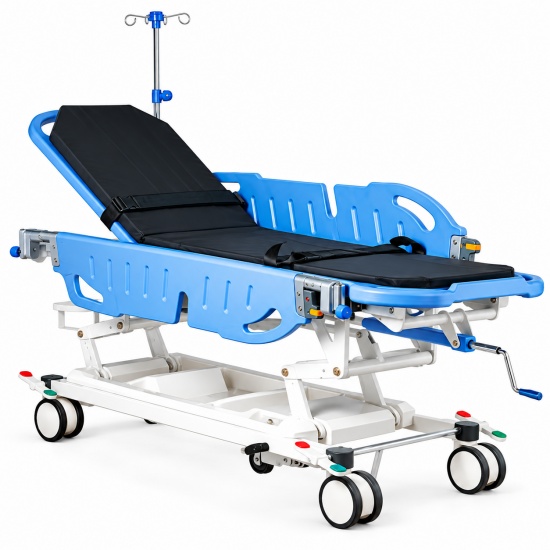
Moving a patient between hospital wards, treatment rooms and other clinical areas requires more than a mobile platform. Caregivers need reliable braking, convenient patient access, adjustable positioning and protective side support throughout the transfer process. The JH-OCT102 patient transfer stretcher is designed around these practical requirements. It combines 510–850 mm height adjustment, a 0–70° gas-spring assisted backrest, horizontally folding side rails with safety locks, 150 mm twin-wheel medical casters and a central braking system in one mobile patient transport platform. With an overall size of 1925 × 663 mm, the stretcher provides a compact and maneuverable solution for routine patient transportation and short-term positioning in hospitals and other professional healthcare environments. The stretcher platform can be adjusted from approximately 510 mm to 850 mm in height. This allows caregivers to reposition the patient surface according to different transfer and clinical care requirements. Height adjustment is particularly useful when the stretcher is positioned beside other patient-care equipment at different working levels. Instead of relying on a single fixed transport height, caregivers can adapt the platform before patient handling or bedside procedures. Adjustable height also provides caregivers with greater flexibility when performing routine patient positioning and care. Raising or lowering the platform can create a more suitable working position depending on the procedure being performed. The backrest can be adjusted from 0° to approximately 70°. A gas-spring assisted mechanism supports the back section during adjustment, allowing caregivers to reposition the patient without using an electric actuator. This allows the stretcher to accommodate both flat lying transportation and a more upright resting position according to the patient's care requirements. Backrest adjustment increases the flexibility of the stretcher when patients need to remain on the platform temporarily before or after transportation. Caregivers can change the upper-body position without transferring the patient immediately to another piece of equipment. The stretcher is equipped with a central braking system with conveniently positioned foot controls. This allows caregivers to operate the caster locking system without individually reaching each wheel during routine positioning. When the stretcher reaches the required location, the braking system can be engaged before patient transfer or care procedures begin. In hospital corridors and clinical departments where stretchers are moved frequently, convenient brake operation is an important part of everyday usability. The central brake configuration simplifies the transition between transportation and stationary patient care. Four 150 mm twin-wheel resin casters support movement through hospital wards, corridors and treatment areas. The twin-wheel configuration provides a broad rolling contact structure for routine patient transportation. The caster system works together with the central braking controls to provide both mobility during transportation and secure positioning when the stretcher is stationary. Protective side rails provide lateral support while the patient is positioned on the stretcher. When caregivers need closer access for transfer, examination, IV procedures or other bedside care, the rails can be lowered horizontally to open the side of the patient platform. This configuration helps balance two different clinical requirements: maintaining side protection during transportation while providing convenient patient access when care procedures are being performed. The side rail system incorporates a safety locking mechanism to help keep the protective components secured in their working position. The locking arrangement is designed for straightforward caregiver operation during routine hospital use. The patient platform and protective components use molded PP construction. The smooth surfaces provide a practical configuration for routine cleaning and everyday operation in professional healthcare environments. The molded design also gives the stretcher a clean medical appearance while integrating the patient support and protective elements into the overall transport system. An IV pole is integrated into the stretcher configuration, allowing infusion support to remain available when required during patient transportation or temporary positioning. This is particularly useful when patients need to move between different hospital departments while continuing prescribed infusion therapy. A hospital transfer stretcher needs to work effectively both while moving and when stationary. For this reason, the JH-OCT102 combines several functions rather than relying on mobility alone. The height-adjustable platform supports different transfer situations, the gas-spring backrest provides patient positioning flexibility, folding side rails allow caregivers to access the patient, and the central braking system helps secure the stretcher after transportation. Together, these features make the stretcher suitable for routine patient movement between hospital wards, treatment areas and other clinical departments. Model: JH-OCT102. Product Type: Height Adjustable Patient Transfer Stretcher. Overall Size: 1925 × 663 × 510/850 mm. Height Adjustment: 510–850 mm. Backrest Adjustment: 0–70°. Backrest Mechanism: Gas-spring assisted adjustment. Patient Platform: Molded PP construction. Side Rails: Horizontally folding side rails with safety locking mechanism. Caster Diameter: 150 mm. Caster Type: Twin-wheel resin medical casters. Brake System: Central braking system with foot controls. Rated Load Capacity: 300 kg. IV Pole: Included. The JH-OCT102 is suitable for hospitals, treatment departments and other professional healthcare environments requiring a mobile platform for patient transportation and temporary positioning. For medical equipment distributors and healthcare project buyers, the combination of adjustable height, central braking, folding side protection and gas-spring backrest adjustment provides a practical specification for routine hospital patient transfer. Explore more Patient Transfer Equipment for additional patient transport and handling solutions. For product specifications, available configurations, OEM/ODM requirements or bulk-order quotations, contact us with your required quantity and project requirements.Height Adjustable Patient Transfer Stretcher for Safer Hospital Transportation
510–850 mm Height Adjustment for Different Transfer Situations
Adapt the Patient Platform to the Care Environment
Improved Working Access for Caregivers
0–70° Gas-Spring Assisted Backrest Adjustment
From Flat Transport to a More Upright Patient Position
Useful Beyond Basic Patient Transportation
Central Braking System for Efficient Stretcher Control
Foot-Operated Central Brake Controls
A Practical Feature for Busy Hospital Workflows
150 mm Twin-Wheel Casters for Hospital Maneuverability
Designed for Movement through Clinical Areas
Folding Side Rails Combine Patient Protection with Open Access
Horizontal Folding Design
Safety Locking Mechanism
Molded PP Components for Everyday Clinical Use
Smooth Patient Platform and Protective Components
Integrated IV Pole for Patient Care during Transportation
Designed around the Complete Patient Transfer Process
Key Technical Specifications
Suitable for Hospitals and Professional Patient Care Facilities