

Three Cranks Tell You What the Bed Can Adjust — Not How Well the Mechanism Works
A hospital buyer compares two manual three-crank beds.
Both specifications look almost identical.
Both provide:
- Backrest adjustment
- Legrest adjustment
- Overall bed height adjustment
Both use steel frames.
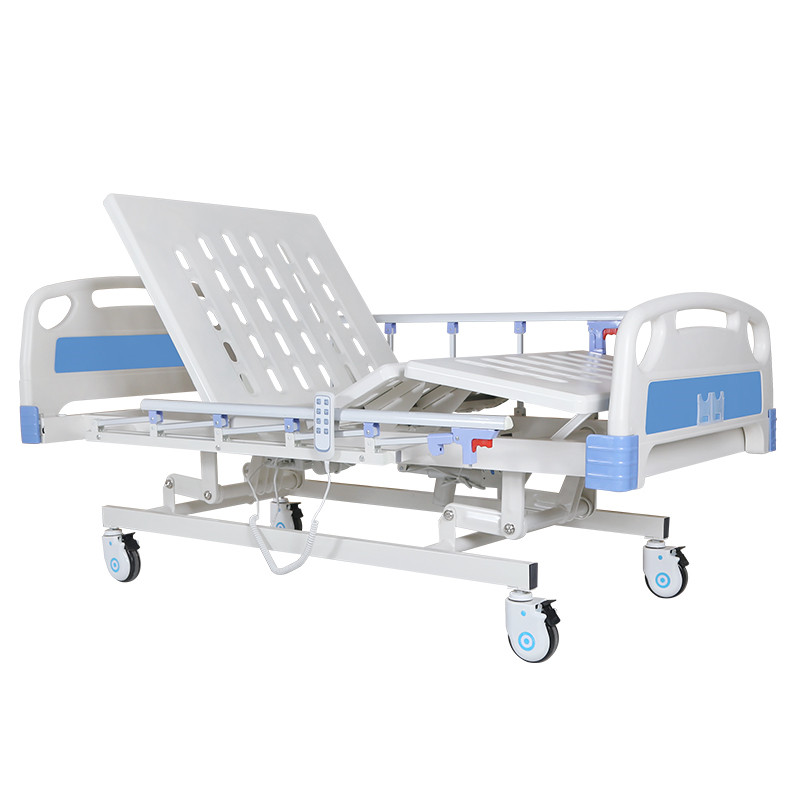
Both have side rails, casters and removable head and foot boards.
Both suppliers describe the product as a Manual 3-Crank Hospital Bed.
Then the buyer operates the samples.
One crank turns smoothly with relatively consistent resistance.
The other feels heavier.
There is more free movement before the bed responds.
The mechanism becomes noticeably harder near part of the adjustment range.
During height adjustment, the frame does not feel as balanced.
This is where the specification sheet stops being enough.
The number of cranks describes the available functions. It does not describe the quality of the mechanical transmission behind those cranks.
A Manual Hospital Bed Is Still a Mechanical System
Because a manual bed has no electric motors, buyers sometimes assume the mechanism is simple.
In reality, each turn of the crank needs to transfer force through several components before the mattress platform moves.
The User Turns the Handle
The rotational movement enters the crank transmission system.
The Transmission Converts Rotation Into Bed Movement
Depending on the bed design, this can involve components such as:
- Screw mechanisms
- Transmission rods
- Connecting joints
- Pivot points
- Linkages
- Lifting structures
Every Connection Affects the Final Operating Feel
A problem does not need to exist in the crank handle itself.
Resistance can originate deeper inside the mechanical system.
Do Not Judge the Crank Mechanism From the Handle Alone
The crank handle is the part the buyer sees and touches.
It is not the entire transmission.
An ABS Retractable Handle Can Improve Storage and Handling
A retractable design can keep the handle closer to the bed when it is not being used.
But the external handle design does not determine whether the complete mechanism operates smoothly.
Look Behind the Handle
During sample inspection, examine:
- Handle connection
- Transmission entry point
- Supporting brackets
- Rod alignment
- Nearby welds
The mechanical path behind the crank matters more than appearance alone.
Free Play Can Tell You Something Before the Bed Even Starts Moving
Place the bed in a middle adjustment position.
Gently rotate the crank in one direction and then the other.
Some Small Mechanical Clearance Can Exist
Moving systems require appropriate fit between components.
But excessive free movement before the bed responds deserves closer inspection.
Compare Several Beds, Not One
If one sample has noticeably more free play than other units of the same model, buyers should investigate whether the difference comes from:
- Assembly variation
- Joint clearance
- Transmission adjustment
- Component fit
The First Ten Turns and the Last Ten Turns Should Both Be Tested
A manual adjustment can feel smooth in the middle of its range while becoming significantly heavier near one end.
Operate the Function From Minimum to Maximum
Do not demonstrate only part of the movement.
Pay Attention to Changes in Resistance
Ask:
- Does the crank remain reasonably consistent?
- Does resistance increase suddenly?
- Does the mechanism produce unusual noise?
- Does the platform hesitate before moving?
The complete range tells the buyer much more than a few turns during a showroom demonstration.
Backrest Adjustment Places Load Through Several Pivot Points
The backrest is one of the most frequently adjusted sections on a manual hospital bed.
Watch the Platform While Turning the Crank
The movement should follow the intended mechanical path without obvious side-to-side distortion.
Look Underneath the Backrest
Inspect:
- Pivot points
- Connecting rods
- Support brackets
- Transmission connection
A smooth mattress platform movement begins underneath the bed.
Backrest Angle Is Not the Only Thing to Compare
Two beds can both reach approximately the same maximum backrest angle.
That does not mean they offer the same operating quality.
Compare the Number of Turns Required
If one mechanism requires significantly more crank rotations to achieve a similar adjustment, the user experience can be different.
Do Not Assume Fewer Turns Are Automatically Better
A very rapid mechanical ratio may require different operating force.
The useful comparison is the balance between:
- Crank effort
- Adjustment speed
- Movement control
Mechanical Ratio Influences Both Speed and Effort
A manual transmission converts human input into movement of a loaded mattress platform.
A Different Mechanical Ratio Can Change the Feel
One design may require more rotations with lower effort.
Another may move faster per rotation but feel heavier.
The Correct Balance Depends on the Intended Product
Buyers should evaluate the bed under realistic operating conditions instead of simply asking which mechanism moves fastest.
The Legrest Mechanism Should Be Tested Separately
The leg section may be adjusted less frequently than the backrest in some wards, but it still deserves independent evaluation.
Operate the Leg Section Through Its Full Range
Watch for:
- Consistent movement
- Platform alignment
- Unusual resistance
- Mechanical noise
- Interference with surrounding parts
Do Not Assume the Backrest and Legrest Use Identical Transmission Quality
They may contain different linkage geometry even though both are operated by cranks.
The Height Crank Is Usually the Most Interesting Mechanical Function on a 3-Crank Bed
Backrest and legrest adjustment move individual mattress sections.
The height system needs to raise or lower the complete bed platform.
This changes the mechanical challenge significantly.
The System Is Moving More of the Bed Structure
The lifting mechanism may be carrying:
- Mattress platform
- Mattress
- Head and foot structures
- Side rails
- Supported load according to the product specification
This Is Why Height Adjustment Deserves More Than One Quick Demonstration
Operate it from the lowest specified position to the highest and back again.
Height Adjustment Needs the Left and Right Sides to Work Together
This is one of the most important structural differences between the height crank and simpler section adjustment.
The Complete Platform Should Remain Appropriately Aligned
During lifting, observe the relationship between:
- Head end
- Foot end
- Left side
- Right side
Look for Obvious Uneven Movement
The bed should not appear to twist unnecessarily as it moves through its designed height range.
Synchronization Problems Can Be Hidden When the Bed Is Empty
An empty demonstration bed places less demand on the lifting structure.
Ask How the Manufacturer Verifies Height Adjustment Under Defined Load Conditions
Professional verification should follow the manufacturer's applicable test procedures and declared limits.
Do Not Perform Unsafe Improvised Overload Tests
The purpose is to understand whether the mechanism remains synchronized under its intended operating conditions, not to exceed the product specification.
A Bed Can Reach the Correct Maximum Height and Still Have Poor Lifting Quality
Suppose both beds specify a height range of approximately 450–720 mm.
Both samples eventually reach those endpoints.
That still does not make the lifting systems equivalent.
Observe What Happens Between the Endpoints
Check whether:
- Movement remains smooth
- Resistance remains controlled
- The platform stays aligned
- The crank does not suddenly become significantly heavier
Endpoint Specifications Are Only Part of the Product
Daily usability exists in the movement between those endpoints.
Transmission Rod Alignment Can Affect Operating Resistance
A mechanical rod works best when installed according to the intended geometry.
Inspect the Rod From Several Angles
Look for obvious:
- Misalignment
- Contact with neighboring frame components
- Unnecessary bending
- Irregular mounting
Small Assembly Differences Can Become Repeated Friction
A component that rubs slightly once may seem unimportant.
A component that rubs every time the bed is adjusted can become a long-term issue.
Welding Fixtures Can Influence Mechanical Alignment
The transmission system is mounted to a welded steel frame.
If the frame geometry varies, the mechanical components attached to it may also sit differently.
This Connects Welding Quality to Crank Quality
A smooth crank mechanism is not only the responsibility of the transmission supplier.
Frame fabrication accuracy can also affect the final assembly.
Compare Multiple Production Frames
For large orders, manufacturing consistency matters more than one carefully adjusted sample.
One Millimeter Does Not Always Matter — But Accumulated Misalignment Can
Mechanical assemblies contain many dimensions and tolerances.
Buyers should not try to create arbitrary microscopic tolerances for every component.
Focus on Functional Alignment
The question is whether normal manufacturing variation causes:
- Increased resistance
- Uneven movement
- Noise
- Interference
- Reduced adjustment range
Performance Is More Important Than Measuring Everything for Its Own Sake
Crank Brackets Need Enough Rigidity to Support Repeated Operation
Every time the user turns the handle, the support structure experiences mechanical force.
Watch the Bracket While Cranking
Check for unnecessary visible movement around the mounting point.
A Strong Handle Mounted to a Weak Bracket Does Not Create a Strong System
The complete load path should be evaluated.
The Handle Connection Should Not Become Loose After Repeated Use
A crank is operated thousands of times during the service life of a manual bed.
Inspect the Connection Between Handle and Transmission
Ask whether:
- The handle feels stable
- The folding or retracting mechanism remains secure
- The crank engages consistently
Repeat the Operation
One successful adjustment is not enough to understand how the interface behaves.
Retractable Cranks Should Be Tested in Both Operating and Stored Positions
A retractable or folding handle is intended to reduce protrusion when it is not in use.
Extend the Handle Fully
Confirm that it reaches its intended operating position.
Return It to the Stored Position
Check whether it remains appropriately contained under or near the bed according to the design.
Do Not Let the Stored Crank Interfere With Casters or Staff Movement
The storage position is part of the product design, not merely an appearance feature.
A Crank That Protrudes Too Far Can Become a Ward-Use Problem
Manual beds are often used in rooms where caregivers, wheelchairs and other equipment move around the foot end.
Look at the Bed From the Foot End
Check how far the crank extends during:
- Normal storage
- Active adjustment
External Dimensions Change While the Handle Is in Use
This should be considered in compact ward environments.
Operating Force Should Be Compared With the Mattress Installed
A completely bare frame does not represent normal use.
Install the Intended Mattress
Then repeat:
- Backrest adjustment
- Legrest adjustment
- Height adjustment
The Complete Bed Configuration Matters
Accessories and mattress weight can change the mechanical load compared with an empty demonstration frame.
Do Not Add Unapproved Lubrication Just to Make a Sample Feel Better
When a manual mechanism feels heavy, the immediate reaction may be to add oil or grease.
Lubrication Should Follow the Manufacturer's Maintenance Procedure
Different joints and transmission components can have different requirements.
Excessive Lubrication Can Create Other Problems
It may attract dust or reach surfaces where it is not intended.
The correct maintenance method should come from the product design and documentation.
Ask Which Transmission Areas Require Routine Maintenance
A manual bed still needs maintenance even though it has no electric motors.
Useful Questions Include
- Which joints require inspection?
- Which components require lubrication, if any?
- How often should the mechanism be checked?
- What symptoms indicate adjustment is needed?
“Manual” Does Not Mean “Maintenance-Free”
Noise Can Help Locate Mechanical Problems
A manual transmission should not be judged only by resistance.
Listen During the Full Adjustment Cycle
Pay attention to:
- Repeated clicking
- Grinding
- Scraping
- Sudden impact sounds
Different Sounds Can Come From Different Locations
Ask the supplier to identify whether the sound comes from:
- Crank mechanism
- Screw system
- Pivot joint
- Platform contact
- Another structural component
The goal is diagnosis, not simply masking the noise.
A New Bed Should Not Need “Breaking In” to Hide Excessive Resistance
Some mechanisms may feel slightly different after repeated operation.
But buyers should be cautious if obvious binding is dismissed simply as:
“It will become better after use.”
Ask Why the Mechanism Is Heavy
A technically useful answer should identify the actual cause.
Do Not Accept Unexplained Resistance as Normal
Especially when another unit of the same model operates much more smoothly.
One Smooth Sample Does Not Prove 300 Crank Systems Will Be Smooth
Bulk procurement changes the quality question.
A 100-bed order of manual three-crank beds contains approximately 300 operating crank systems.
Production Consistency Becomes Critical
The buyer is no longer purchasing one mechanism.
The buyer is purchasing hundreds of repeated mechanical assemblies.
Random Inspection Should Include Every Crank Type
Do not test:
- Only the backrest crank
- Only the easiest bed to reach
- Only the golden sample
Bulk Inspection Should Compare Crank Effort Across Several Beds
Exact laboratory force measurement may not be necessary for every project unless it forms part of the specification.
But comparative consistency can still be evaluated.
Select Random Finished Units
Operate:
- Backrest crank
- Legrest crank
- Height crank
Look for Outliers
If nine beds operate similarly and one requires noticeably more effort, that unit deserves further inspection.
Height Synchronization Should Be Included in Pre-Shipment Inspection
The height crank is especially important because it changes the complete platform position.
Move From Lowest to Highest Position
Observe the frame throughout the travel.
Return to Minimum Height
Check whether the mechanism returns consistently without obvious skewing or interference.
Do Not Accept a Bed That Needs the Crank to Be Forced Beyond Its Intended Stop
At the end of an adjustment range, the mechanism reaches its designed limit.
The Operator Should Understand When the Limit Has Been Reached
Excessive force should not be used to try to obtain additional movement beyond the specified range.
Staff Training Matters
Caregivers should understand the intended operation of the manual adjustment system.
Over-Tightening at the End of Travel Can Increase Wear
When users repeatedly continue turning a mechanical control after the intended adjustment has reached its limit, unnecessary stress may be introduced.
Operating Instructions Should Address This
Simple staff guidance can help protect the mechanism.
The Best Mechanical Design Still Needs Appropriate Use
Crank Direction Should Be Consistent and Clearly Understood
For a three-crank bed, staff need to remember three different controls.
Common Operating Logic Helps
Where possible, movement direction should be intuitive and consistently communicated.
Use Labels or Symbols Where Appropriate
A caregiver should be able to identify which crank controls:
- Backrest
- Leg section
- Height
without repeatedly experimenting.
Do Not Place Three Identical Cranks Without Clear Function Identification
The external handles may look the same.
The functions are different.
Ask How the Functions Are Identified
This can involve:
- Position
- Symbols
- Labels
- Color coding where appropriate
Usability Is Part of Mechanical Product Quality
The Crank System Should Remain Accessible When the Bed Is Against a Wall
Manual hospital beds are often placed in crowded wards.
Check the Foot-End Working Space
Staff need enough room to extend and rotate the handles.
A Bed Can Fit the Room While the Cranks Cannot Be Operated Properly
External clearance should therefore be considered during ward planning.
Bedside Accessories Should Not Block Crank Operation
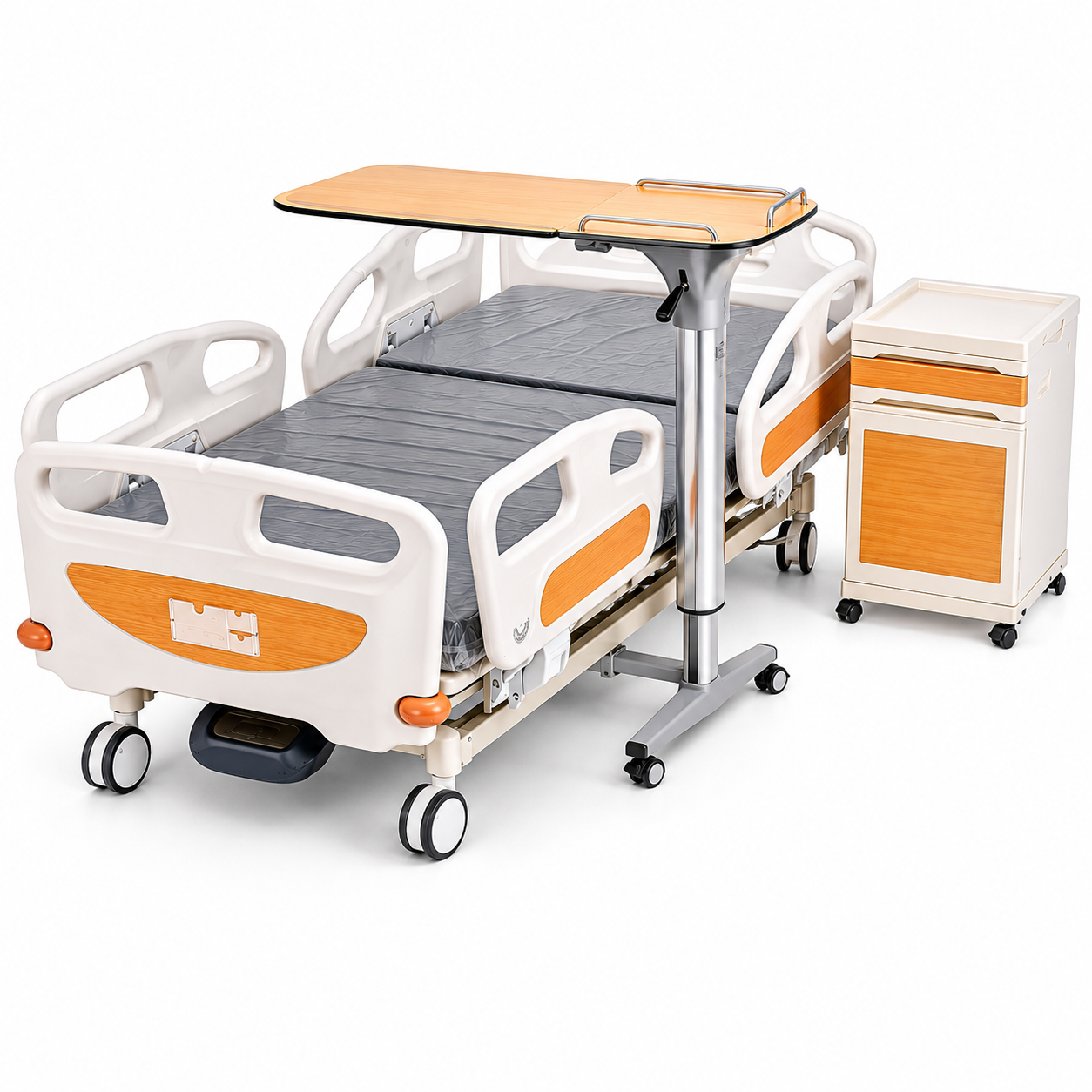
An overbed table, cabinet or other furniture can migrate toward the foot end.
Operate All Three Cranks With the Intended Room Setup
Check whether surrounding equipment restricts handle movement.
Manual Functions Need Physical Operating Space
This is an important difference from push-button electric adjustment.
A Bent Crank Is Often a Symptom, Not the Original Problem
If users need excessive force to operate a mechanism, the handle itself can eventually experience abnormal stress.
Do Not Replace Only the Handle Without Finding the Cause
The underlying issue may involve:
- Transmission resistance
- Misalignment
- Mechanical interference
- Damaged linkage
Repair Should Follow Diagnosis
Replacement Crank Assemblies Should Match the Original Transmission
Years after purchase, a hospital may need to replace a crank component.
Ask Whether Replacement Assemblies Are Available
Keep information such as:
- Bed model
- Crank assembly reference
- Transmission type
- Mounting details
A Similar-Looking Handle Is Not Automatically Compatible
Screw and Transmission Components Matter More Than Decorative Crank Style
A metal handle may look stronger than an ABS-covered handle.
That appearance alone does not define transmission durability.
Evaluate the Components Carrying the Mechanical Load
The handle begins the movement.
The internal system performs the work.
Do Not Use Handle Material as a Shortcut for Complete Product Quality
Frame Rigidity and Crank Smoothness Are Connected
If the supporting structure flexes or moves excessively, the transmission geometry can change under operation.
Watch the Frame While Adjusting Height
Check for unnecessary movement around:
- Transmission brackets
- Lifting links
- Support points
Mechanical Functions Should Be Evaluated as Part of the Complete Bed
Manual Beds Still Need Accurate Manufacturing Fixtures
A simple product does not mean loose production control is acceptable.
Repeatability Matters
Jigs and fixtures can help manufacturers maintain consistent:
- Frame geometry
- Bracket position
- Transmission alignment
- Platform assembly
This Is Where Factory Capability Affects Everyday Crank Feel
A buyer may never see the welding fixture after delivery, but its influence can remain in the finished bed for years.
Ask the Factory to Demonstrate the Mechanism Before the Mattress Is Installed
This is an especially useful inspection method.
Look Underneath While Someone Operates Each Crank
Watch:
- Transmission rod movement
- Pivot action
- Linkage movement
- Lifting structure
Do Not Stand Only at the Foot End
The handle tells you what the operator feels.
The underside tells you why.
A Factory Video Can Show More Than a Product Specification Sheet
For overseas buyers, request one continuous demonstration.
Ask the Supplier to Show
- Flat bed position
- Backrest crank from minimum to maximum
- Legrest crank from minimum to maximum
- Height crank from minimum to maximum
- Underside transmission movement
- Cranks returning to stored position
Keep the Sound On
Mechanical noise can provide useful information that a silent edited video removes.
Sample Approval Should Record More Than the Three Adjustment Angles
A buyer may approve:
- Backrest 0–75°
- Legrest 0–45°
- Height 450–720 mm
and still fail to record how the manual mechanism actually performs.
Add Operational Checks to the Sample Record
For example:
- All three cranks operate smoothly
- No obvious excessive free play
- No abnormal noise
- Height system remains appropriately aligned
- Handles retract or fold correctly
Use the Approved Sample as a Production Reference
Do Not Reduce Price by Quietly Changing the Crank Transmission System
Manual hospital beds are often highly price competitive.
A buyer may ask several suppliers to reduce cost repeatedly.
Ask What Changed
Possible cost changes can involve:
- Crank assembly
- Transmission components
- Bracket construction
- Handle type
- Other structural parts
The Final Quotation Should Describe the Actual Configuration
Price negotiation should not turn a known sample into an unknown production bed.
The Cheapest Crank Is Not Cheap if Staff Fight With It for Five Years
Mechanical usability creates a long-term labor issue.
One Heavy Crank Used Once Is a Minor Inconvenience
The same heavy crank used every day across 100 beds becomes a repeated operational problem.
Evaluate Lifecycle Use, Not Only Component Cost
A small improvement in mechanism quality can influence thousands of future adjustments.
A Better Manual 3-Crank Hospital Bed RFQ Should Define the Mechanical System
Instead of writing only:
“Manual hospital bed, three cranks,”
a stronger procurement specification can include:
Functions
- Backrest adjustment range
- Legrest adjustment range
- Overall height range
Crank Design
- Folding or retractable configuration
- Storage position
- Function identification
Mechanical Performance
- Smooth operation through full travel
- No obvious abnormal mechanical interference
- Controlled height lifting
- Appropriate frame alignment
Maintenance
- Required routine inspection
- Lubrication guidance where applicable
- Replacement crank availability
- Transmission component availability
Verification
- Sample function test
- Underside mechanism inspection
- Random bulk production testing
This describes a much more meaningful product than “three manual functions.”
Use a Simple Six-Step Crank Test Before Approving the Sample
Step 1: Start With the Bed Flat
Check all handles and their stored positions.
Step 2: Raise the Backrest Fully
Count the approximate operating effort and listen for noise.
Step 3: Raise and Lower the Leg Section
Watch the linkage and platform alignment.
Step 4: Move the Bed From Minimum to Maximum Height
Observe the complete frame, not only the crank handle.
Step 5: Return Every Function to Its Starting Position
Confirm smooth movement in both directions.
Step 6: Repeat the Same Test on Another Bed
Consistency is one of the most important indicators for a bulk order.
The Quality of a Manual Hospital Bed Is Hidden in the Force Between Your Hand and the Mattress Platform
Manual three-crank beds are often described as simple equipment.
That simplicity can be an advantage.
There are no electric actuators required to create the three main adjustments.
But simple operation still depends on precise mechanical manufacturing.
The crank handle, transmission, screw mechanism, linkage, lifting frame and welded support structure all need to work together.
This leads to a useful procurement principle:
Do not compare two manual 3-crank hospital beds only by asking whether both can raise the backrest, leg section and bed height. Turn every crank through its complete range and pay attention to how the mechanism gets there.
The specification tells you where the bed can move.
The crank tells you how well the bed was built to make that movement thousands of times.
Hebei Heyuan Medical Equipment Co., Ltd. manufactures manual hospital beds, electric hospital beds and medical patient beds in different structural and functional configurations for hospitals, distributors and healthcare projects.
Buyers can explore our Manual Hospital Bed range to compare different crank, side rail, caster and mattress-platform configurations.
For hospital projects, distributors or bulk manual hospital bed purchasing, please contact us with the required quantity, functions and technical specifications.