

A 300-Bed Hospital Does Not Need 300 ICU Beds
A hospital project is planning to purchase 300 patient beds.
One supplier proposes a large quantity of high-specification ICU beds.
Another recommends using standard electric hospital beds for most wards and reserving advanced ICU models for critical-care areas.
Which proposal is more reasonable?
The answer cannot be determined simply by comparing bed prices or choosing the model with the most functions.
A hospital normally contains several clinical environments with very different patient-care requirements.
Intensive care, emergency observation, surgical recovery, general inpatient wards and lower-acuity departments do not necessarily require the same Hospital Bed configuration.
This creates an important procurement question:
How many ICU hospital beds does the project actually need, and where should higher-specification beds be allocated?
Answering that question correctly can prevent two expensive mistakes.
The first is under-specification: purchasing beds that cannot adequately support the intended clinical workflow.
The second is over-specification: paying for advanced functions across hundreds of beds where those functions may rarely be used.
Start With Clinical Areas, Not the Total Number of Beds
Break the Project Into Bed-Use Zones
Before requesting quotations, procurement teams should separate the total hospital capacity into functional areas.
Depending on the project, these may include:
- Intensive care units
- High-dependency units
- Emergency and observation areas
- Post-operative recovery areas
- General medical wards
- General surgical wards
- Specialty departments
- Pediatric areas
- Isolation rooms
A 300-bed hospital should therefore not begin with the question:
“Which 300 beds should we buy?”
A better starting point is:
“What does each clinical area require the bed to do?”
ICU Capacity Is the First Obvious Group
If the architectural and clinical plan defines 24 intensive-care spaces, those rooms create the first group of likely ICU-bed requirements.
But procurement should not stop at the room count.
Confirm What the ICU Team Expects From the Bed
Depending on the hospital and selected model, requirements may include:
- Electric backrest adjustment
- Electric leg positioning
- Electric height adjustment
- Trendelenburg positioning
- Reverse Trendelenburg positioning
- CPR-related operation
- Central braking
- Side-rail controls
- Bed-end controls
- Battery backup
These requirements should come from the project's approved specification rather than from the assumption that every bed marketed as an “ICU bed” has the same configuration.
High-Dependency Areas Need a Separate Decision
Some hospitals operate high-dependency or step-down areas between intensive care and ordinary inpatient wards.
Patients in these areas may need more frequent positioning and closer observation than patients in standard wards.
Do Not Automatically Copy the ICU Specification
The correct bed may be an ICU configuration.
It may also be a simpler multifunction electric hospital bed.
The decision should follow actual clinical requirements.
Emergency Areas Can Create Another High-Acuity Requirement
Emergency departments may need beds for patients whose condition has not yet been fully stabilized or classified.
Ask What Happens During the First Hours of Care
Does the bed need rapid repositioning?
Will critically ill patients remain on it?
Will the bed move frequently?
Does the department require central braking or emergency positioning features?
These workflow questions are more useful than simply asking whether an emergency department “needs ICU beds.”
Post-Operative Areas Should Also Be Reviewed Separately
Recovery and post-operative environments may require frequent position changes and close patient access.
Again, Function Should Drive Configuration
The project team should determine whether a full ICU configuration is necessary or whether another electric hospital bed can meet the requirement.
Most General Wards May Not Need the Highest ICU Specification
General Ward Requirements Are Often Different
Consider a hospital with 300 beds.
Suppose a large proportion of those beds belong to ordinary medical and surgical wards.
Patients still need safe positioning and caregivers still need efficient working height.
But this does not automatically mean that every room requires the hospital's highest-specification ICU model.
A Three-Function Electric Bed May Be Sufficient in Some Wards
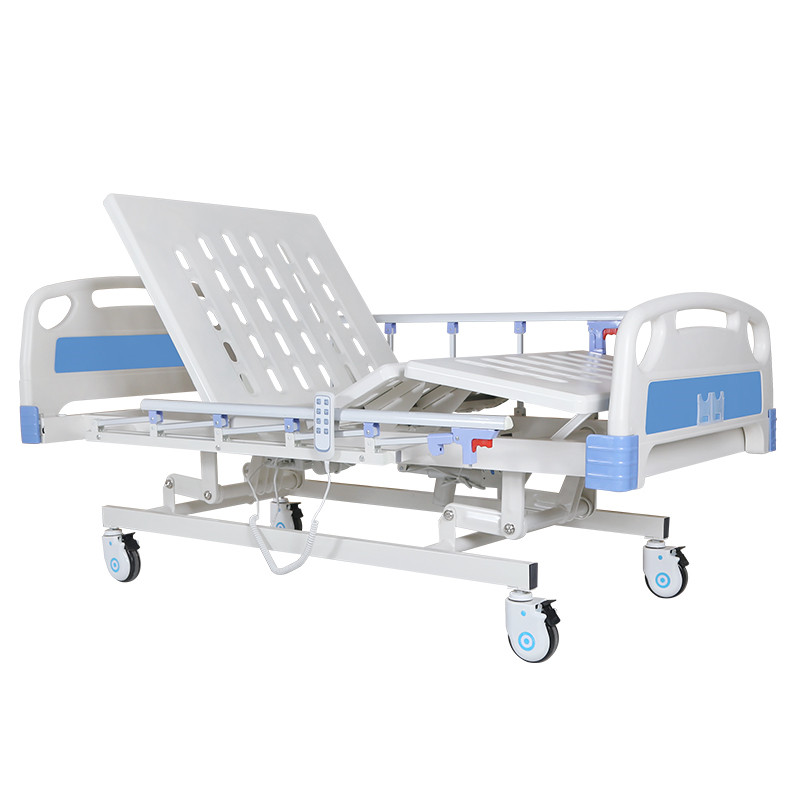
A typical electric three-function configuration may provide:
- Backrest adjustment
- Leg adjustment
- Height adjustment
Where these movements match the approved clinical requirement, adding functions that are rarely used may increase the project cost without producing equivalent operational value.
Other Wards May Benefit From a Five-Function Bed
Where Trendelenburg and reverse Trendelenburg positioning are required, a five-function electric hospital bed may be more appropriate.
This Creates a Middle Specification Tier
The hospital does not necessarily have to choose only between:
basic bed
and
fully equipped ICU bed.
A project can use several carefully defined specification levels.
Manual Beds May Still Have a Role in Some Projects
Budget, local infrastructure, maintenance capability and intended clinical use vary significantly between hospital projects.
Do Not Eliminate Manual Beds Only Because Electric Models Offer More Functions
In some applications, a manual hospital bed may satisfy the required workflow while reducing electrical-system complexity.
The decision should be based on the tender requirement and care environment.
Build a Hospital Bed Allocation Matrix Before Requesting Prices
Do Not Send Suppliers Only a Total Quantity
A request such as:
“Please quote 300 hospital beds.”
does not give the supplier enough information to prepare a meaningful project configuration.
Separate the Quantity by Department
For example, an illustrative project might begin with a structure such as:
- ICU: 24 beds
- High-dependency unit: 16 beds
- Emergency/observation: 20 beds
- Surgical wards: 80 beds
- Medical wards: 100 beds
- Other departments: 60 beds
This is only an example of how to organize the discussion, not a recommended ratio for every hospital.
Actual quantities must follow the approved hospital plan.
Now Define Required Functions for Each Group
For every department, procurement should identify whether it requires:
- Backrest adjustment
- Leg adjustment
- Height adjustment
- Trendelenburg
- Reverse Trendelenburg
- Emergency functions
- Battery backup
This Prevents Function Count From Becoming the Only Selection Rule
Two departments may both use electric beds while requiring different control systems, rails, brakes or emergency features.
Define the Brake System Separately
Bed mobility can vary greatly by department.
Ask How Often the Bed Will Be Moved
A frequently transported bed may justify a different caster and braking configuration from a bed that normally remains in one room.
Define the Side-Rail Requirement
Different models may use different rail structures and control arrangements.
Check Clinical Access as Well as Patient Protection
Procurement teams should evaluate how caregivers approach the patient when the rails are raised, lowered or opened.
Define Control Access
Some electric beds use a handset.
More advanced models may provide additional controls on the rails or footboard.
More Controls Are Not Automatically Better
The question is whether the clinical team will actually use them.
Do Not Forget Reserve Beds
Installed Capacity and Purchase Quantity May Not Be Identical
Suppose a hospital has 24 ICU spaces.
Ordering exactly 24 ICU beds may appear mathematically correct.
But what happens when one bed is temporarily unavailable?
Maintenance Can Remove a Bed From Service
Possible reasons include:
- Component replacement
- Electrical troubleshooting
- Accidental damage
- Deep cleaning
- Preventive inspection
Reserve Strategy Should Be Defined by the Hospital
There is no universal reserve percentage that should automatically be applied to every project.
Consider Local Service Conditions
The required reserve strategy can depend on:
- Local spare-parts availability
- On-site biomedical capability
- Supplier response time
- Bed utilization
- Criticality of the department
One Reserve Bed Does Not Necessarily Need to Exist for Every Model
If several departments use compatible platforms, the hospital may have greater flexibility.
Model Standardization Can Influence Reserve Planning
This is one reason why procurement should evaluate the entire bed fleet rather than purchase each department independently.
Over-Specifying Every Hospital Bed Can Become Expensive Very Quickly
Small Unit-Price Differences Become Large Project Differences
Consider an illustrative example.
If a higher specification adds USD 300 to each bed, the difference across 300 units becomes USD 90,000.
If the additional specification adds USD 600 per bed, the difference becomes USD 180,000.
This Does Not Mean Buyers Should Choose the Cheapest Bed
The point is different.
Every specification should have a reason.
Ask What Each Additional Function Solves
Before upgrading an entire ward, ask:
- Which clinical task requires this function?
- How frequently will staff use it?
- Does the tender explicitly require it?
- Does it reduce caregiver workload?
- Does it support emergency workflow?
If Nobody Can Explain Why a Function Is Needed, Review the Requirement Again
Controls Can Also Increase Cost
An ICU bed with multiple integrated control panels may cost more than a model operated mainly through a handset.
Evaluate Who Needs Control Access
If the additional control points solve a real workflow problem, they may be valuable.
If they will rarely be used, procurement should understand why they are being specified.
Brake Systems Affect Cost and Workflow
Central braking can be valuable where beds move frequently.
But Again, Apply It Intentionally
Do not copy one specification across the entire project without considering department use.
Accessories Can Quietly Increase the Project Budget
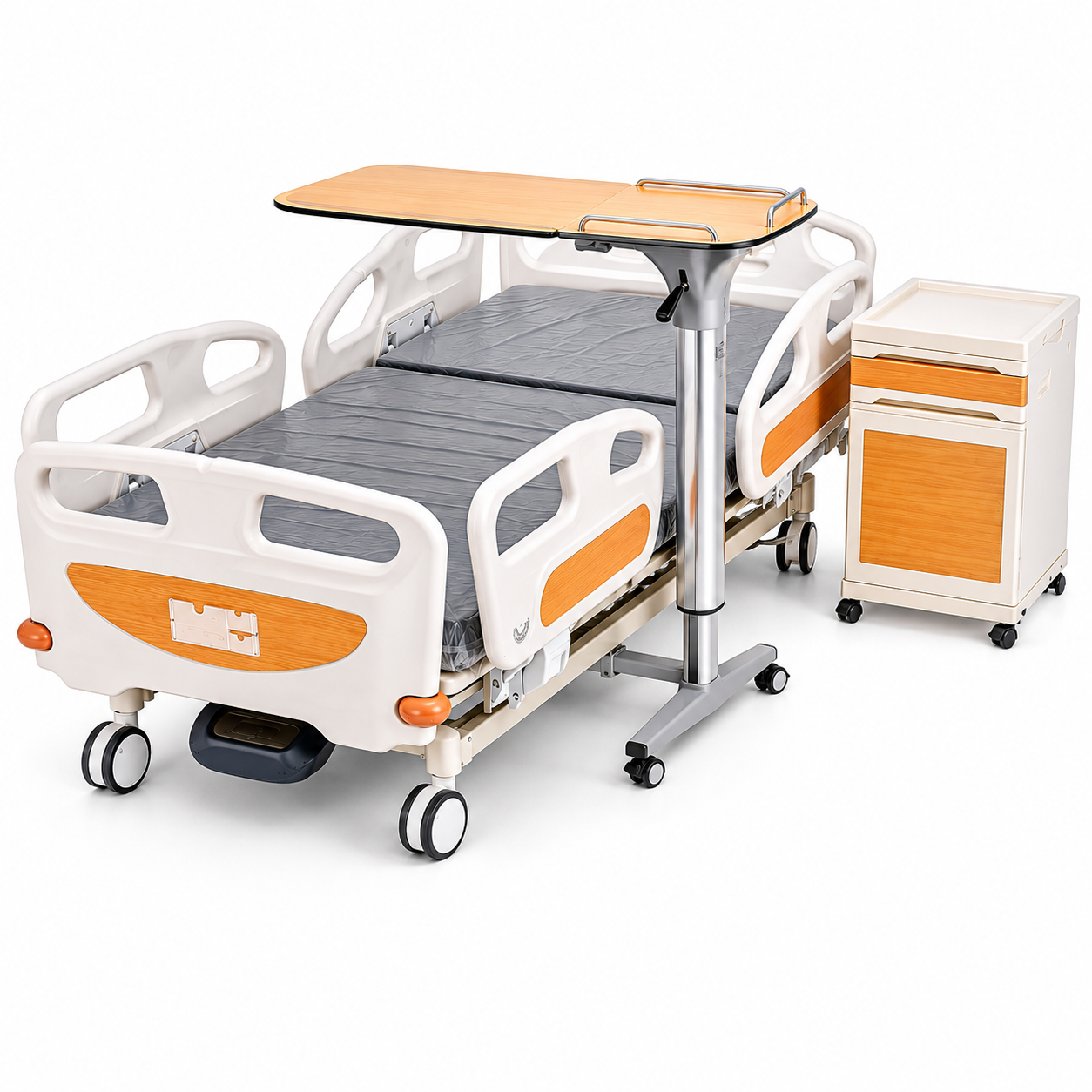
A bed quotation may include or exclude items such as:
- Mattress
- IV pole
- Overbed table
- Bedside cabinet
- Battery
- Additional accessories
Compare Complete Configurations Rather Than Bed Frames Alone
Under-Specifying Critical Areas Can Be the More Expensive Mistake
Do Not Reduce ICU Specification Only to Meet a Target Price
Cost control should remove unnecessary specification.
It should not remove functions that the clinical team genuinely requires.
Critical-Care Beds Should Be Evaluated Against Critical-Care Workflow
If the department requires frequent electric positioning, emergency operation and advanced control access, those requirements should remain visible in the purchasing decision.
Minimum Bed Height and Maximum Bed Height Can Matter
Do not compare only the number of functions.
Ask for Actual Adjustment Ranges
Two five-function beds can have different:
- Height ranges
- Backrest angles
- Leg angles
- Tilt ranges
Safe Working Load Should Be Confirmed
The required load capacity should be defined according to the hospital's intended patient population and procurement specification.
Request the Manufacturer's Confirmed Value
Emergency Functions Need More Than a Product-Page Icon
If CPR-related operation is required, buyers should understand exactly how the selected model performs it.
Ask for Demonstration and Documentation
Standardization Can Reduce Complexity Across the Hospital
Too Many Models Create Their Own Cost
Imagine a hospital purchasing:
one ICU bed from Supplier A,
one electric ward bed from Supplier B,
another surgical bed from Supplier C,
and a different manual bed from Supplier D.
The initial purchase may satisfy every department individually.
But the hospital may later manage several unrelated systems.
This Can Increase
- Spare-parts variety
- Staff training requirements
- Maintenance documentation
- Supplier coordination
- Accessory compatibility issues
Look for Platform Commonality Where Practical
Different bed specifications may sometimes share certain components or operating principles.
Ask the Manufacturer Directly
Potential commonality may include:
- Actuator families
- Control systems
- Casters
- Mattress dimensions
- Accessory mounting points
Compatibility should always be confirmed for the exact models being considered.
Staff Familiarity Has Operational Value
If controls and rail operation are reasonably consistent across departments, staff moving between wards may require less model-specific familiarization.
Standardization Does Not Mean Every Bed Must Be Identical
The goal is controlled variation rather than unnecessary complexity.
For a 300-Bed Project, Compare Several Configuration Scenarios
Scenario A: High Specification Across Most Departments
This may simplify purchasing but can create significant over-specification if many advanced functions are rarely used.
Scenario B: Minimum Specification in Most Departments
This may reduce initial investment but risks under-specifying higher-acuity areas.
Scenario C: Department-Based Specification Tiers
This approach separates beds according to clinical use.
For Example
The hospital might evaluate:
- ICU-level electric beds for critical care
- Five-function electric beds for selected higher-acuity wards
- Three-function electric beds for standard inpatient areas
- Manual configurations where clinically and operationally appropriate
The exact mix must follow the hospital's approved requirements.
Scenario C Often Produces the Most Useful Procurement Discussion
Not because it is automatically correct for every hospital, but because it forces the project team to connect specification with actual use.
Send Suppliers a Bed Schedule Instead of Asking for One Generic Quote
Department
State where each bed will be used.
Quantity
Separate installed units and any required reserve quantity.
Functions
Define required movements rather than requesting “high specification.”
Adjustment Ranges
Specify required ranges where the tender or clinical team has defined them.
Control System
Identify whether handset, rail controls or bed-end controls are required.
Side Rails
Define the preferred structure and operating requirement.
Brake System
Specify individual caster brakes or central braking where required.
Emergency Requirements
Identify CPR-related or other required emergency functions.
Electrical Requirements
Include voltage, plug and battery requirements where applicable.
Accessories
State whether mattresses, IV poles, bedside cabinets, overbed tables or other items belong in the quotation.
Documentation
List the technical and regulatory documents required for the destination market and project.
Ask the Hospital Bed Manufacturer to Quote by Configuration
Do Not Request Only One Total Price
A better quotation separates each bed tier.
This Allows Procurement to See the Cost of Each Decision
For example:
What is the difference between a three-function and five-function electric bed?
What is the cost of central braking?
What is the cost of the selected control system?
What accessories are included?
Ask for Exact Model Numbers
This prevents different configurations from being discussed under one generic product name.
Every Quoted Tier Should Be Traceable to a Defined Model
Request Technical Datasheets With the Quotation
The commercial offer and technical specification should agree.
Check Functions, Dimensions, Load Capacity and Electrical Information
Request Real Product Photos and Function Videos
These help the project team understand rail operation, controls, braking and bed movement before sample evaluation.
Visual Evidence Should Support, Not Replace, Technical Documentation
A Practical Eight-Step Method for Planning ICU and Ward Bed Quantities
Step 1: Confirm the Total Approved Bed Capacity
Start with the actual project plan.
Step 2: Divide Capacity by Clinical Department
Do not treat the hospital as one uniform bed environment.
Step 3: Define the Required Bed Functions for Each Department
Connect every major function to a clinical or operational requirement.
Step 4: Identify Which Areas Truly Require ICU-Level Configuration
Do not automatically extend the ICU specification into standard wards.
Step 5: Determine Whether Intermediate Electric Configurations Are Appropriate
Three-function and five-function models can create useful specification tiers.
Step 6: Define the Reserve Strategy
Consider maintenance capability, utilization and criticality.
Step 7: Compare Total Project Cost Across Several Mixes
Calculate the cost of the complete bed schedule rather than comparing only individual unit prices.
Step 8: Request Samples for the Highest-Volume and Highest-Criticality Models
Validate the configuration before committing to mass production.
The Right Question Is Not “How Many ICU Beds Can We Afford?”
A hospital project should not begin by buying the most advanced bed everywhere.
It should also not begin by minimizing specification everywhere.
Both approaches ignore how hospitals actually operate.
The better process is to understand the patient-care environment first.
Which departments manage the highest-acuity patients?
Where is frequent repositioning required?
Where are emergency controls important?
Which beds move most frequently?
Which wards can operate efficiently with a simpler electric configuration?
How many reserve units are necessary?
And how much complexity will the selected model mix create for maintenance and training?
Once those questions are answered, the number of required ICU hospital beds becomes much easier to define.
A well-planned hospital project does not purchase the maximum specification for every room. It places the right hospital bed specification in the right clinical environment.
That approach can protect clinical requirements while avoiding unnecessary project cost.
Hebei Heyuan Medical Equipment Co., Ltd. manufactures ICU hospital beds, electric five-function hospital beds, electric three-function hospital beds, manual hospital beds and related medical furniture for hospitals, distributors and healthcare projects.
Buyers can review our Hospital Bed range to compare different configurations for ICU, inpatient and general hospital applications.
If you are planning a new hospital, hospital expansion or bulk medical-bed procurement project, please contact us with the total bed quantity, department breakdown, required functions, destination country and project schedule. We can then discuss a more appropriate configuration structure for your project.